
Every vessel that carries radio at all carries VHF. Far fewer carry HF, and owners considering an MF/HF set usually want to know one thing first: how much further will it actually reach? The honest answer is that the two bands are not two grades of the same product. They propagate by completely different physical mechanisms, and understanding that difference explains everything else, including why a more powerful VHF set does not buy you meaningfully more range.
Why VHF stops at the horizon
Marine VHF works in the band around 156 to 163 MHz. At those frequencies radio waves travel in essentially straight lines and are not reflected back to earth by the upper atmosphere. What you get is line of sight propagation, extended slightly by atmospheric refraction, which means range is governed almost entirely by antenna height at both ends rather than by transmitter power.
This is why a 25 W fixed set on a masthead antenna reaches far further than a 6 W handheld at deck level, and why a small boat calling a large ship or a coast station gets a much better result than two small boats calling each other. A typical small craft to small craft working range is a handful of miles. Calling a coast station with a high antenna, or a ship with a tall superstructure, commonly gives several tens of miles. Raising output from 1 W to 25 W helps at the margins and helps punch through noise, but it does not put the signal over the horizon.
The practical planning rule is simple: if the vessel operates within reliable coverage of coast stations and other traffic, VHF is the right and sufficient tool. Under GMDSS this coastal band of VHF DSC coverage from coast stations is what defines sea area A1, and equipment carriage requirements are built around which sea areas a vessel actually operates in.
Why HF crosses oceans
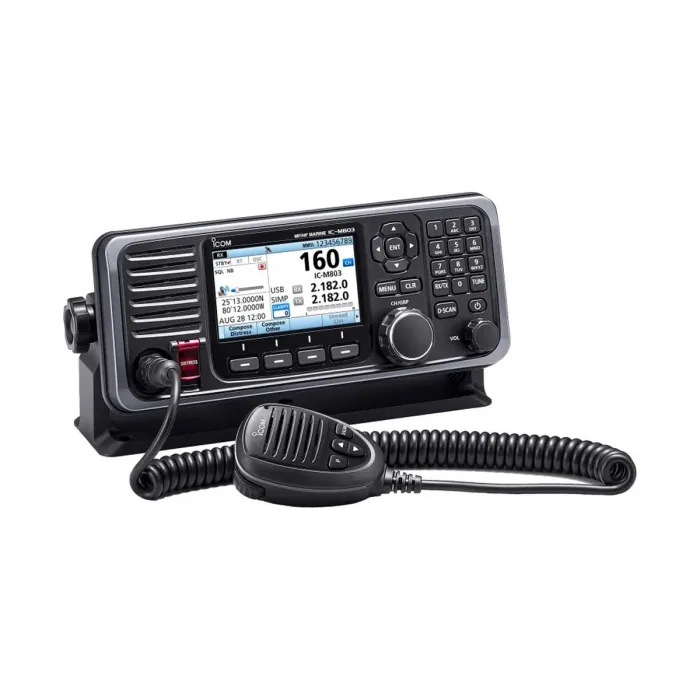
MF and HF marine radio works in a far lower band, broadly from the 2 MHz distress and calling region up through the marine bands in the high frequency spectrum. Signals at these frequencies are refracted by the ionosphere and returned to earth well beyond the horizon, sometimes after multiple hops. That is the whole reason HF exists on a vessel: it is not incrementally better than VHF, it is a different mechanism that reaches from mid ocean to a shore station thousands of miles away with no infrastructure in between.
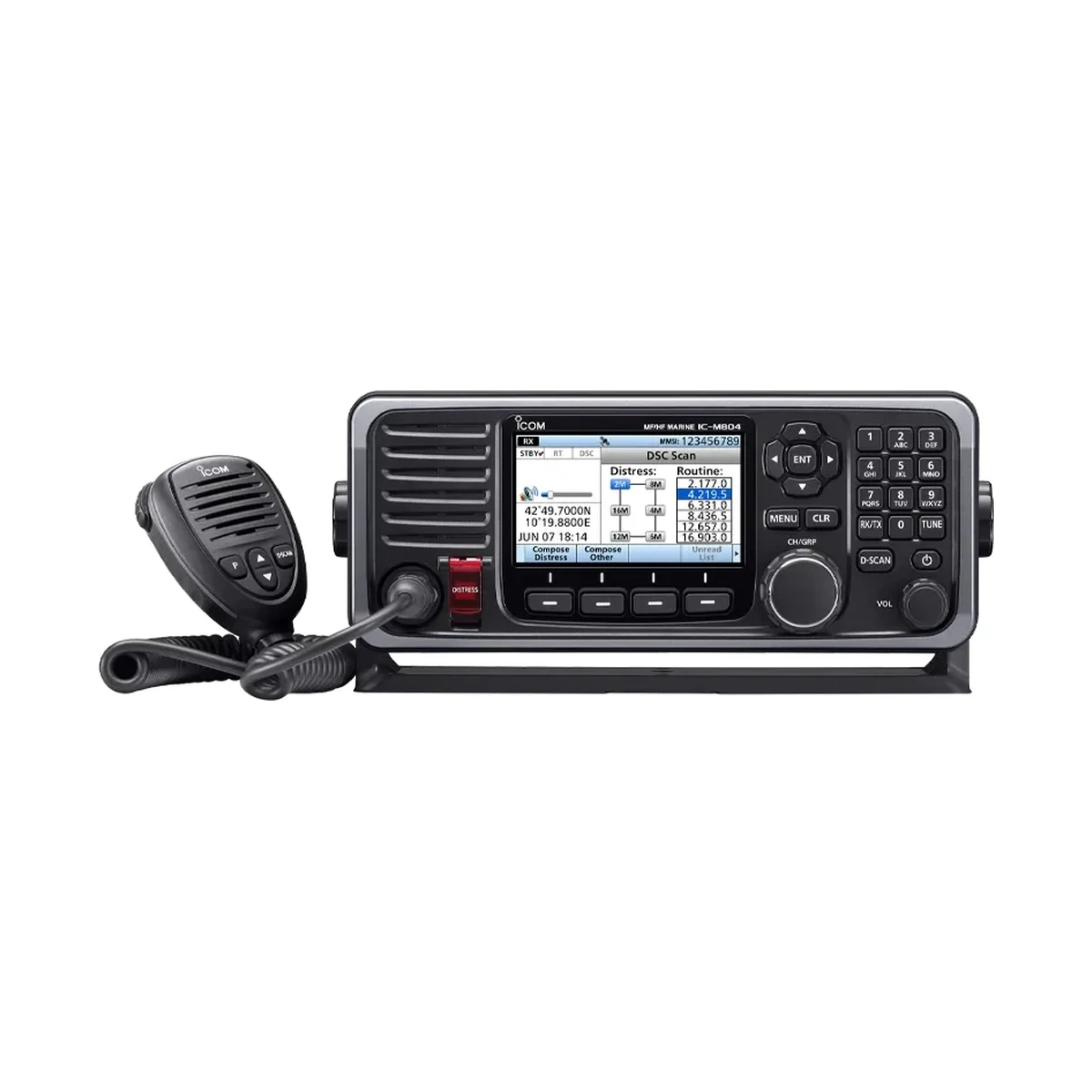
The tradeoff is that ionospheric propagation is variable. Which band works depends on the time of day, the season and solar conditions, so an HF operator selects a band to suit the path and the hour rather than simply keying up. Lower bands generally serve at night and over shorter distances, higher bands during the day and over longer paths. HF sets also demand a serious installation: a good antenna and tuner, a proper ground or counterpoise on a non conductive hull, and a supply that can deliver the transmit current. The Icom IC-M804 marine SSB, for example, delivers 85 W PEP on the lower bands and 125 W PEP from 4 MHz upwards, and can draw up to 40 A on transmit from a 12 V supply, which tells you plainly that this is a planned installation and not a bracket mount job.
Which one your vessel needs
- Coastal and harbour work, within coast station coverage: VHF with DSC, fixed mount for the vessel and handhelds as backup.
- Offshore passages beyond VHF coverage: HF or satellite in addition to VHF, never instead of it.
- SOLAS regulated vessels: carriage is set by sea area, and a full GMDSS radio station typically pairs a VHF set with an MF/HF set, which is exactly how Icom describes the GM600 VHF and GM800 MF/HF working together as one station.
- Fishing vessels operating well out from the coast: HF is often the only way to reach shore without satellite airtime costs.
DSC ties the two together
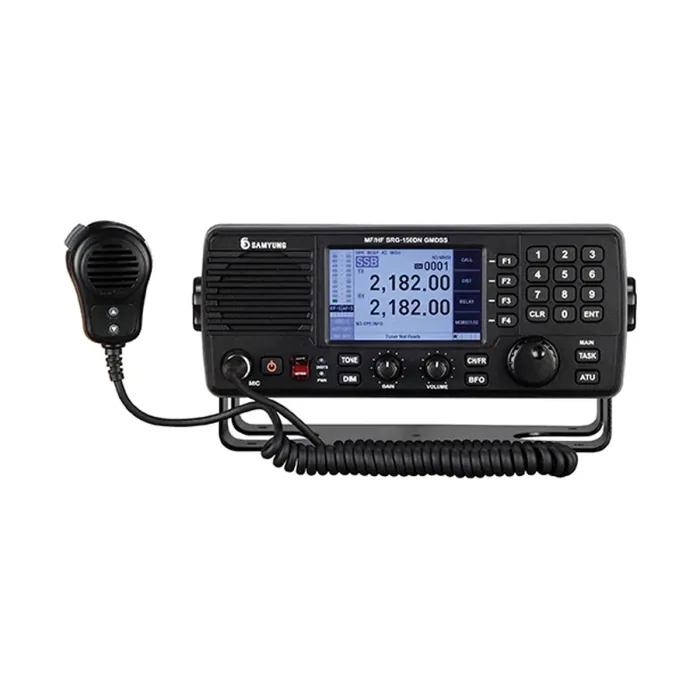
Digital selective calling runs on both bands and is the reason GMDSS works as a system. On VHF, DSC uses channel 70. On MF and HF it uses a set of dedicated distress and calling frequencies, and a GMDSS MF/HF set keeps a watch on all of them at once. The Samyung SRG-150DN, for instance, watch keeps on 2187.5, 4207.5, 6312, 8414.5, 12577 and 16804.5 kHz. In both cases the alert carries the vessel's MMSI and, where the radio is fed position data, its position, so a receiving station knows who is calling and from where before anyone speaks.
Fitting both properly
Most working vessels end up with VHF for everything routine and HF or satellite for the passages where VHF cannot help. The two do not compete for the same job. ASPL supplies, installs, commissions and services marine VHF, HF and GMDSS equipment for commercial vessels, fishing fleets and workboats across India, including the bridge interfacing that feeds GPS position into the DSC side of both sets.