
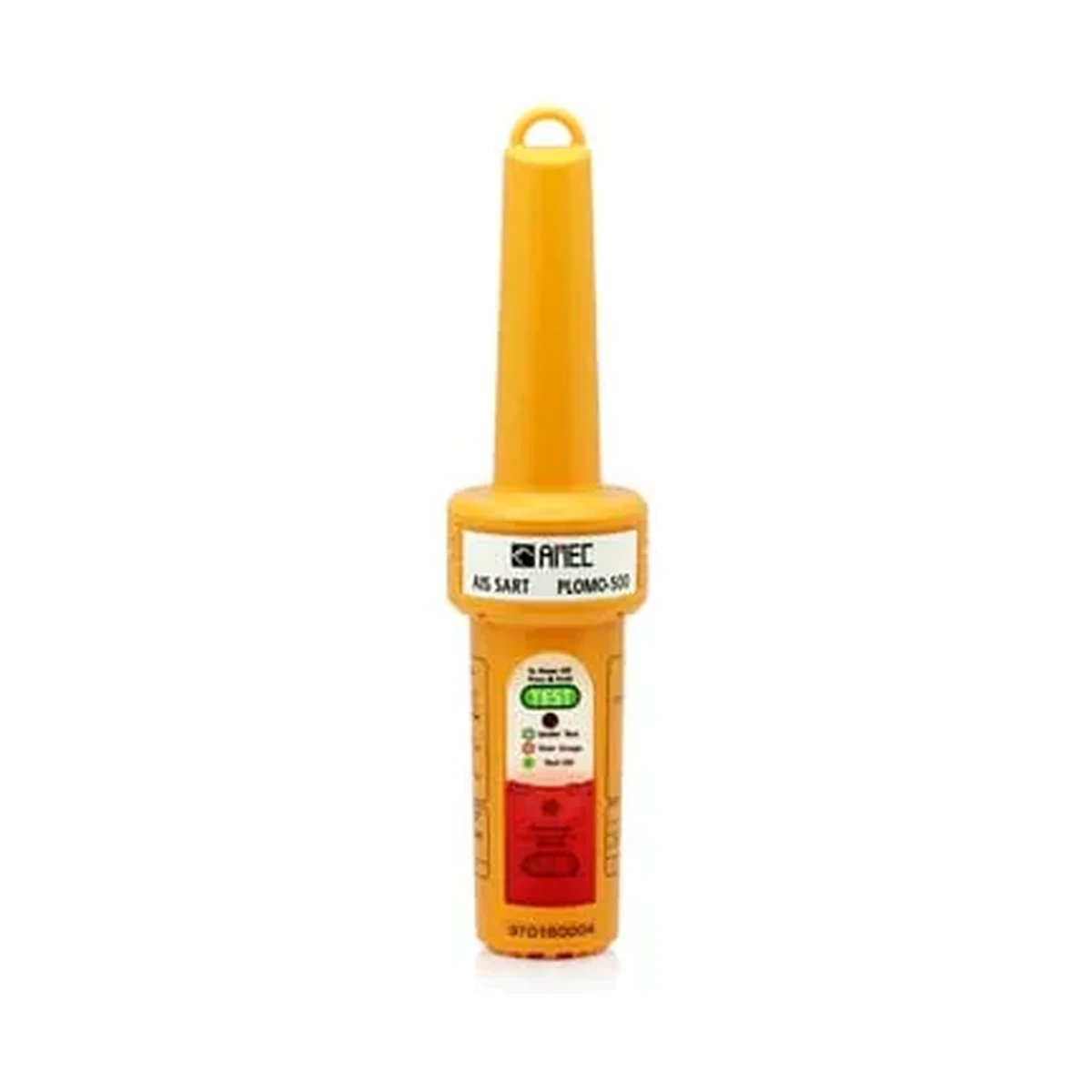
A Search and Rescue Transmitter is a locating device carried so that a survival craft, or a person, can be found. The older form is the radar SART, which responds to a searching vessel's X-band radar with a pattern of blips along the bearing line. The newer form is the AIS SART, which does something rather different: it works out its own position from GPS and broadcasts that position as an AIS message, so it appears as a target on the AIS display of every vessel within VHF range without anyone needing to be actively searching for it.
How an AIS SART works
An AIS SART contains a GNSS receiver and a low-power VHF transmitter operating on the two international AIS channels, 161.975 MHz and 162.025 MHz. Once activated it acquires a fix and begins transmitting AIS Message 1, carrying its unique identifier and its GPS position, together with Message 14, the safety-related broadcast that flags the transmission as an active SART rather than ordinary traffic. Any AIS-equipped vessel in range plots it, and a receiving installation that recognises the message type raises an alarm and shows the target with a distinct icon.
The AMEC Plomo 500 is a representative example: it transmits Message 1 and Message 14 at 1 W EIRP on both AIS frequencies, uses a 72-channel GPS receiver accurate to better than 2.5 m, floats, is rated for immersion to 10 m, and extends on a 1050 mm pole so the antenna sits as high above the water as possible. Its replaceable primary lithium battery gives a minimum of 96 hours of operating life once activated, with a 6-year storage life before replacement, and it is built to IEC 61097-14, IEC 60945, ITU-R M.1371-5 and IMO Resolution MSC.246(83).
Why the pole height matters so much
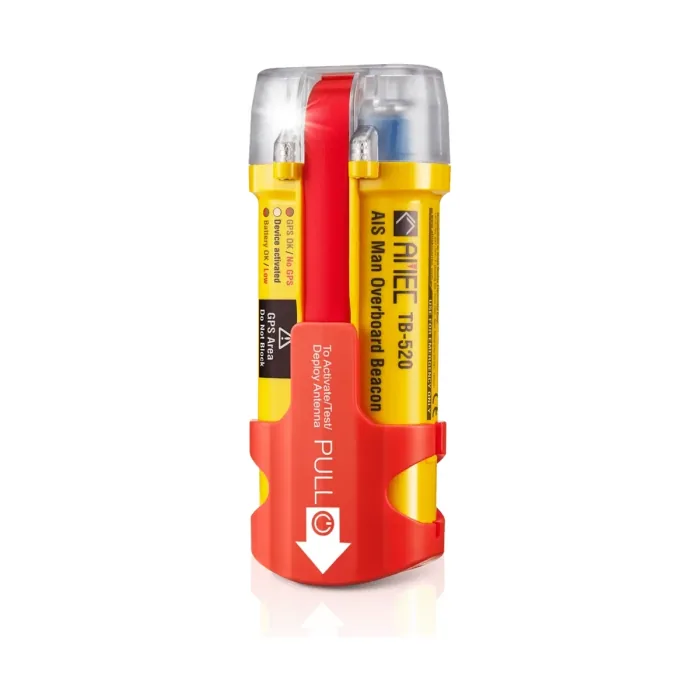
Everything about an AIS SART's usefulness comes down to VHF line of sight, and both ends of the path are close to the water. That is why these devices are designed to be raised: a metre of extra antenna height on a liferaft is a meaningful fraction of the total path budget. It is also why the receiving vessel's antenna height matters. The 4 nautical mile range quoted for the AMEC TB520 MOB beacon, for instance, assumes a receiving antenna more than 5 m above sea level.
AIS SART compared with a radar SART
Both are approved locating devices, and they fail in different ways, which is the argument for understanding the distinction rather than treating them as interchangeable.
- A radar SART is passive until interrogated. It only shows anything when a vessel's X-band radar sweeps it, and someone has to be looking at the radar screen to notice the response.
- An AIS SART is active. It transmits on its own schedule and puts a position on screen whether or not anyone is searching, and it gives an actual latitude and longitude rather than a bearing and a rough range.
- A radar SART's response degrades gracefully into a distinctive visual pattern that an experienced operator recognises immediately. An AIS SART depends on the receiving equipment correctly handling the message type.
- An AIS SART's usefulness depends on there being AIS-equipped vessels in range. A radar SART depends on there being X-band radar in range.
AIS SART compared with an AIS MOB beacon
These are related but distinct devices. An AIS SART is a survival craft locating device, built to a GMDSS standard, typically stowed in the liferaft or an emergency grab bag, with a long battery endurance so it can keep transmitting through an extended search. An AIS MOB beacon is a personal device worn by the individual, activated manually or automatically by water immersion, and intended for the much shorter timescale of recovering someone who has gone over the side from a vessel still nearby. The AMEC TB520 is an example of the latter: a 2 W AIS transmitter with a 72-channel GPS, sending Message 1 and Message 14 once a minute, with a manual or water-activated trigger, an SOS LED and a typical 72 hours of battery life once activated.
When it saves lives, and what has to be true for it to work
The scenario an AIS SART is built for is the one where a vessel has been abandoned and the survivors are in a raft with no way to communicate their position. Search assets and passing traffic get a precise, continuously updated position instead of a search area. That is the difference between a directed recovery and a pattern search, and in cold water or bad weather it is a difference measured in hours.
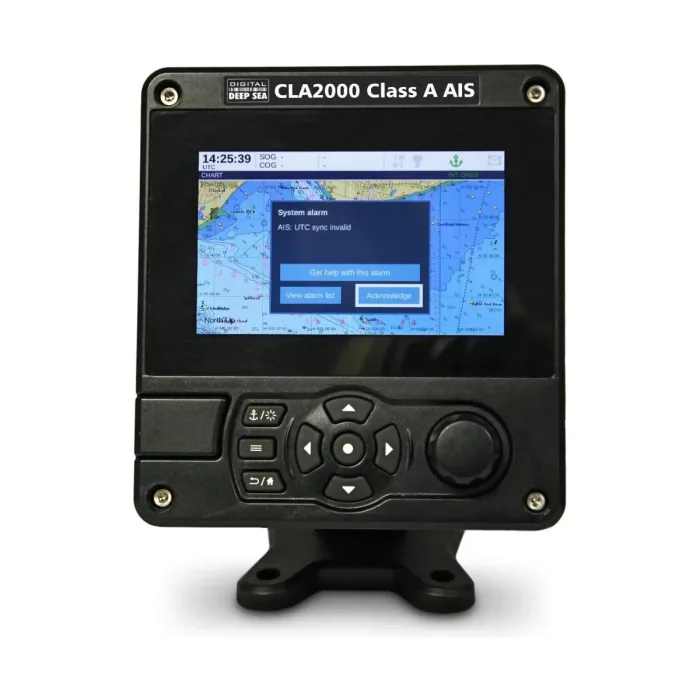
For that to happen, several things have to be in place beforehand. The device needs a live battery within its service date, which is a routine inspection item rather than an afterthought. It needs to be stowed where it can actually be reached when the vessel is being abandoned. And the vessels most likely to be nearby need AIS equipment that treats a SART transmission as an alarm rather than as one more target in the list. Some transponders handle this explicitly: the Digital Yacht CLA2000 has optimised software for detecting AIS SART and MOB devices with a dedicated icon and an automatic alarm on activation, and the AIT2500 offers an AIS SART alarm option intended for use alongside personal AIS MOB devices.
SOLAS carriage of search and rescue locating devices is set out in Chapter III, which requires them to be carried aboard ships according to size, and an AIS SART is an accepted alternative to a radar SART for that purpose. ASPL supplies GMDSS equipment, AIS SARTs and marine VHF for commercial vessels and fishing fleets in India, alongside the transponders and receivers that make a SART transmission visible in the first place.