
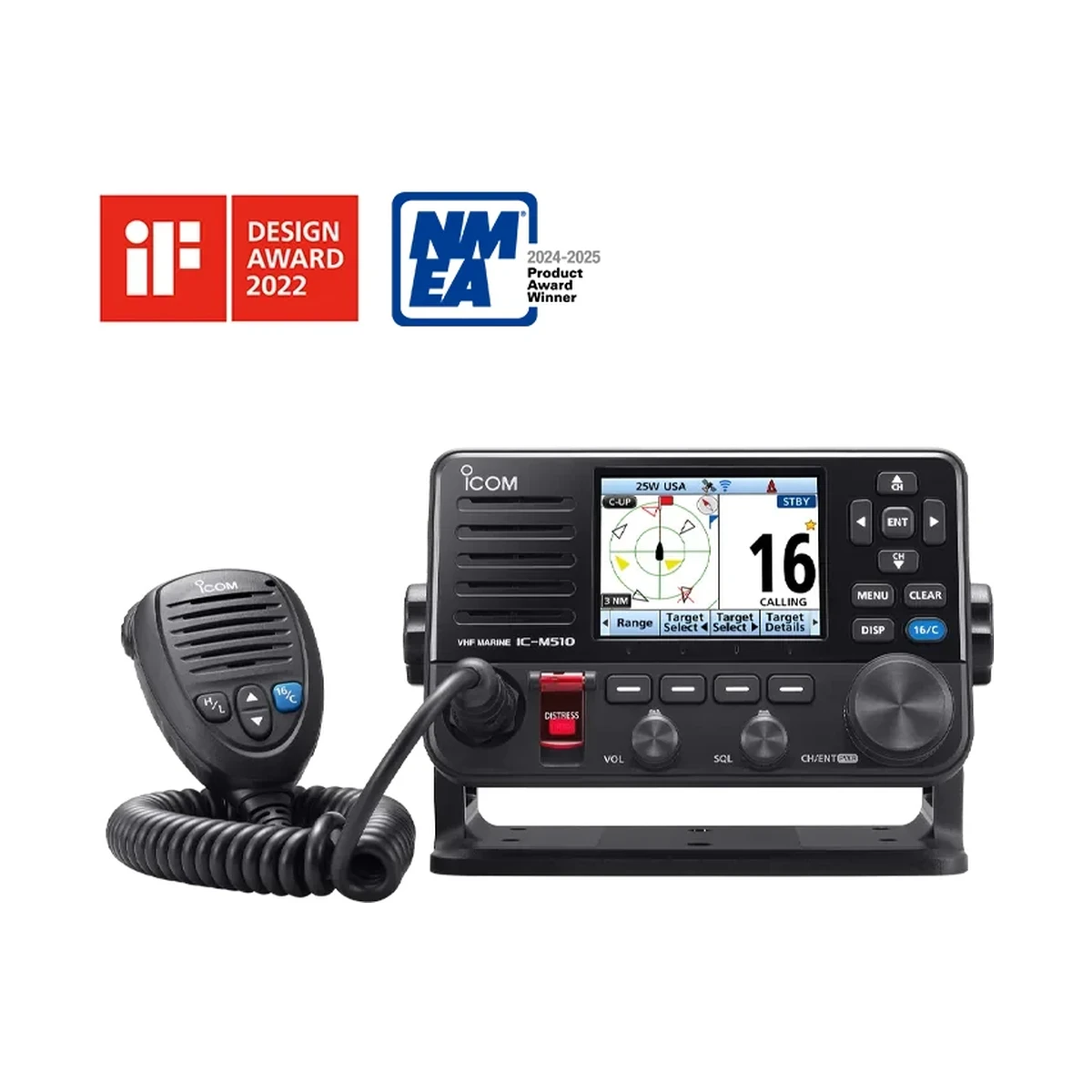
What the IC-M510EVO is
The IC-M510EVO is Icom's fixed-mount Class D VHF/DSC marine radio, positioned as the flagship evolution of the IC-M510 Class D with Wi-Fi and RemoteCommander. It transmits from 156.025 to 157.425 MHz, receives from 156.050 to 163.275 MHz, keeps a dedicated DSC watch on 156.525 MHz, and carries a two-channel AIS receiver on 161.975 and 162.025 MHz. Output switches between 25 W and 1 W from a 13.8 V DC supply (usable range 11.7 to 15.9 V), drawing 5.0 A on high power. The set measures 175 x 110 x 53 mm, weighs about 730 g without the microphone, and is rated from -20 C to +60 C.
Those are ordinary numbers for a modern fixed-mount set, and deliberately so. Nothing about the wireless side changes what the radio does as a radio: the same 25 W into a 50 ohm antenna, the same DSC distress alerting, the same AIS receive.
What the Wi-Fi module actually is
The built-in wireless LAN is IEEE802.11 b/g/n on the 2.4 GHz band, channels 1 to 13, with WEP (64/128 bit), WPA-PSK (TKIP) and WPA2-PSK (AES) authentication and encryption. Wi-Fi output power is rated at less than 10 mW/MHz.
Read those figures carefully, because they set expectations. Less than 10 mW/MHz on 2.4 GHz is a short-range local link, the sort of coverage a domestic access point gives inside a house. It is a network between the radio and a device on the same vessel, not an internet connection and not a second communications path off the boat. If the VHF antenna cannot reach a station, no amount of Wi-Fi will help. The wireless link is a control and display channel for the radio, and the RemoteCommander function is what it exists to support.
Why a second control point is worth having
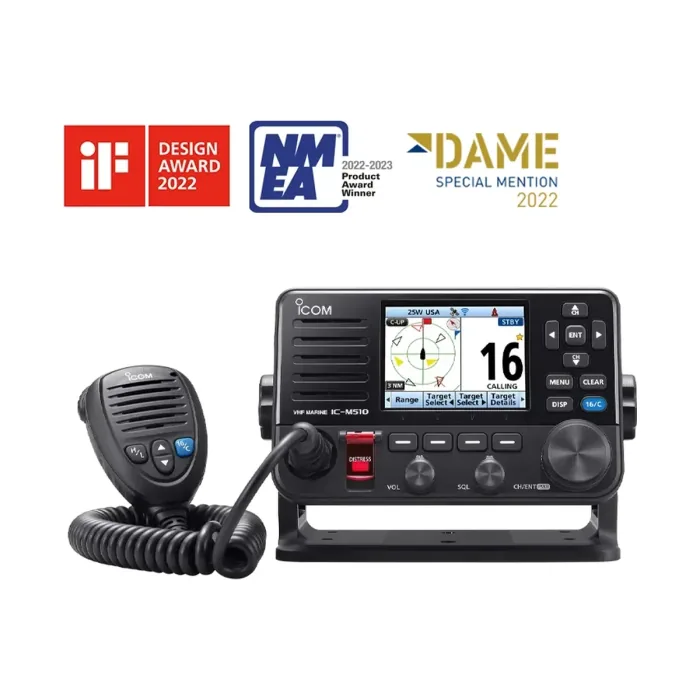
On most boats the fixed VHF ends up wherever the panel space was, which is rarely where the crew is. A flybridge helm, a cockpit, a foredeck during an anchoring manoeuvre, a bridge wing during a berthing evolution: all places where the person who needs to answer a call is nowhere near the set. The traditional fix is a wired second station, which means another run of cable and another hole in a bulkhead. A wireless control link removes that installation work, and it lets the second control point move around instead of staying bolted in one place.
The IC-M510EVO's specification sheet shows the same thinking on the audio side. It supports the HM-195 command microphone (receive current rises to 2.0 A with one connected), drives an external speaker at more than 15 W, and includes hailer functions rated at 25 W typical, with a receive hailer at 20 W typical. With an external speaker, receive hailer and HM-195 all in use, maximum receive current reaches 7.3 A, which is the figure that should size the supply circuit rather than the 1.6 A the radio draws on its own.
How it differs from the IC-M510 Class D
The two sets are close relatives, and the specifications say so. Both cover the same transmit and receive ranges, both carry DSC on 156.525 MHz and dual-channel AIS receive, both weigh about 730 g, and both carry the same 802.11 b/g/n Wi-Fi module with the same encryption options and the same sub-10 mW/MHz output. The visible differences are on the audio and current side: the IC-M510EVO is specified at 5.0 A on 25 W transmit against 5.5 A for the IC-M510 Class D, and it publishes hailer and command-microphone figures the earlier sheet does not. If you already run an IC-M510 Class D, the EVO is a refinement of the same platform rather than a different class of radio.
Practical points before ordering
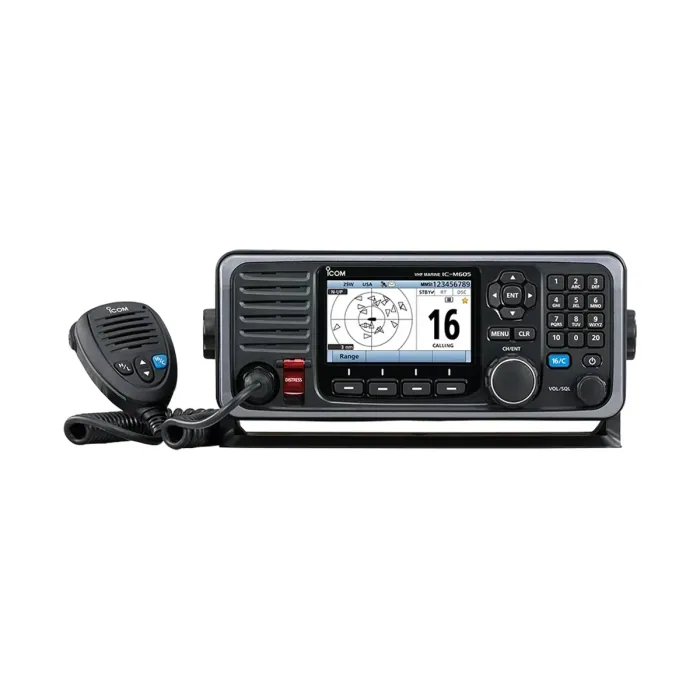
Three things decide whether the radio performs as specified once it is on the boat. The antenna and its feeder matter far more than the set, since a 25 W transmitter into a poor cable run is a weaker station than a well-fed 1 W one. The DC circuit needs to be sized for the loaded current draw and properly fused, not spurred off an existing instrument feed. And the DSC side is useless until the correct MMSI is programmed and a position source is connected or acquired, because a DSC distress alert without a position is a much harder alert for a coast station to act on.
ASPL supplies Icom marine VHF alongside AIS, GMDSS and NMEA interfacing equipment, and fits, interfaces and commissions bridge electronics rather than shipping boxes. If a wireless-controlled set is being specified as part of a wider bridge fit, it is worth planning the antenna, power and NMEA connections at the same time.