
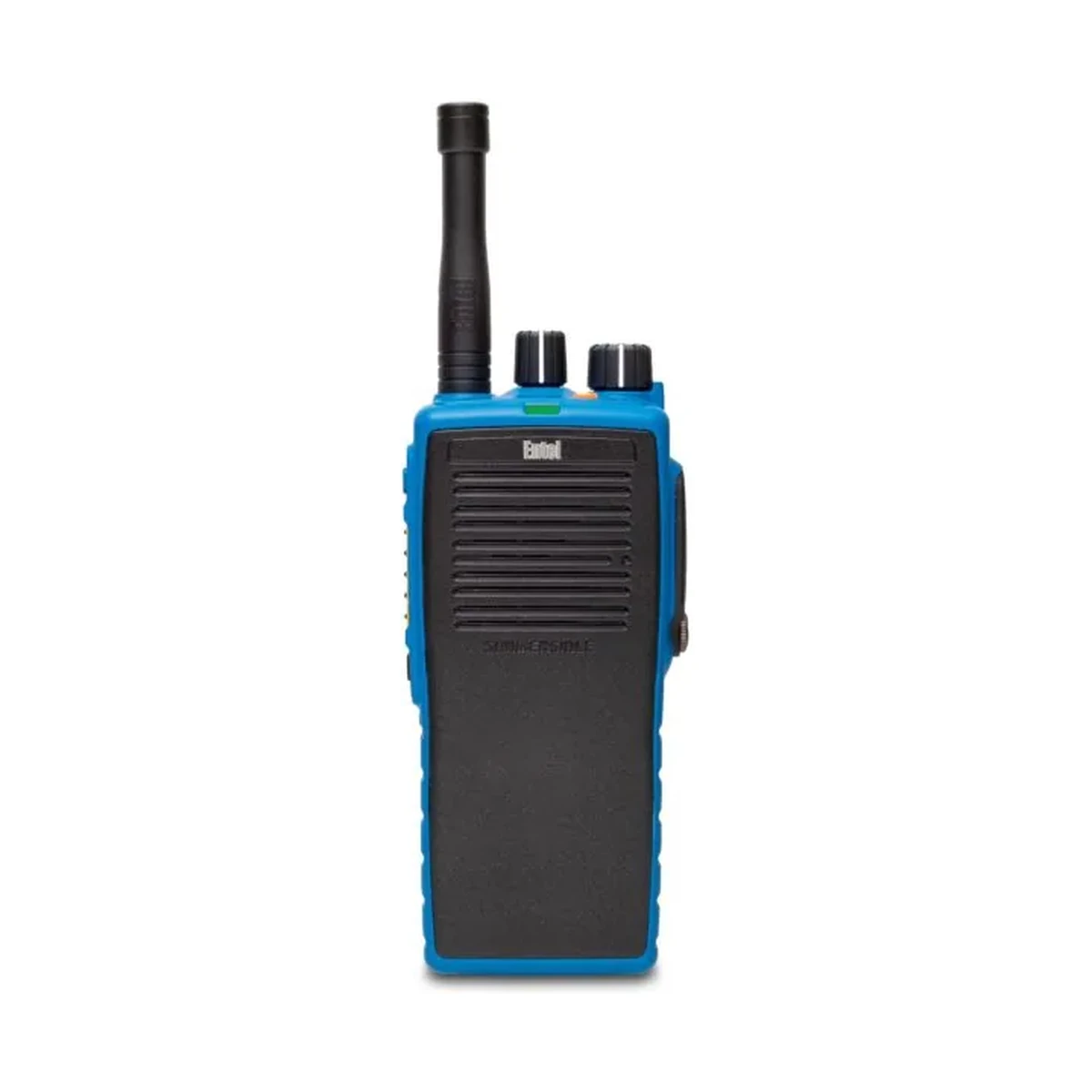
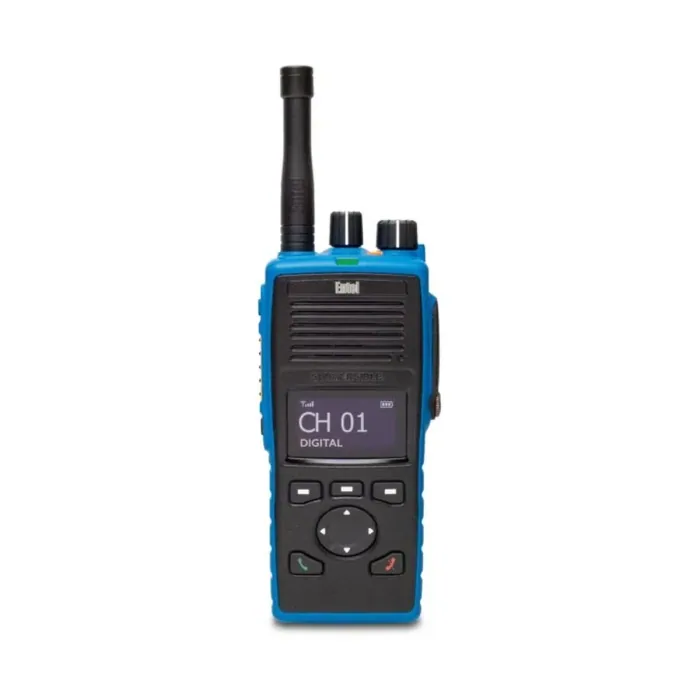
ATEX is the European Union directive, 2014/34/EU, governing equipment intended for use in potentially explosive atmospheres, and equipment certified under it carries a specific alphanumeric marking that looks dense but is actually a compact, precise specification. The Entel DT982M, for instance, is certified to II 2G Ex ib IIC T4 Gb. Reading that marking correctly is the difference between confirming a radio is genuinely suitable for a given site and simply trusting a label.
Equipment group and category: II 2
The Roman numeral identifies the equipment group. Group I covers equipment for underground mining; Group II covers surface industries, which is where two-way radios for refineries, chemical plants and tank farms fall. The number that follows, the category, states how much protection the equipment provides and, correspondingly, which zone it can be used in: Category 1 for the most severe, continuously hazardous zones, Category 2 for zones where a hazardous atmosphere is likely to occur periodically during normal operation, and Category 3 for zones where it is unlikely and, if it occurs, only briefly. A radio marked II 2 is built for Category 2 use.
Gas or dust: G
The letter G indicates the equipment is certified for explosive gas atmospheres, as opposed to D, which would indicate certification for combustible dust atmospheres. Some equipment carries both markings if tested and approved for each; a radio marked only G should not be assumed suitable for a dust-hazard environment without confirming that separately.
Protection method: Ex ib
Ex indicates the equipment employs a recognised explosion-protection method, and ib specifies which one and to what level. Intrinsic safety, the ib and ia markings, works by limiting the electrical and thermal energy in a circuit to a level too low to ignite a surrounding explosive atmosphere even under fault conditions, rather than trying to contain an explosion after the fact. The letter following the protection method, b in this case, denotes the level of protection: ia is the higher level, suitable for Category 1 zones, and ib is suitable for Category 2 zones, matching the II 2 category already stated earlier in the marking.
Gas group: IIC
This states which specific gases the equipment has been tested against, since different gases require different minimum spark energy to ignite and some are considerably easier to ignite than others. IIA covers gases such as propane, representing a lower ignition risk; IIB covers gases such as ethylene, a step up in required protection; IIC covers gases such as hydrogen and acetylene, the most easily ignited, and equipment rated IIC provides the broadest gas coverage, since IIC-rated equipment is also suitable for IIB and IIA atmospheres. Equipment rated only IIB is not automatically suitable for a IIC atmosphere. This distinction is covered in more depth in the dedicated IIB-versus-IIC article elsewhere in this series.
Temperature class: T4
This states the maximum surface temperature the equipment can reach under normal and fault conditions, expressed as a temperature class rather than a raw figure: T4 corresponds to a maximum surface temperature of 135°C. The relevance is straightforward: a hot surface can itself act as an ignition source for a surrounding explosive atmosphere, independent of any spark, so equipment is rated against the ignition temperature of the gases it may be exposed to.
Equipment Protection Level: Gb
The final segment, Gb, is the Equipment Protection Level, a more direct statement of the equipment's protection level for gas atmospheres: Ga is the highest level, suitable for Zone 0; Gb suits Zone 1; Gc suits Zone 2. This is covered in more depth in the dedicated zone-matching article elsewhere in this series, but the short version is that Gb-rated equipment, such as the DT982M, is built for Zone 1 use.
Reading the whole marking together
Put together, II 2G Ex ib IIC T4 Gb states: surface-industry equipment, Category 2, certified for gas atmospheres, protected by intrinsic safety at the ib level, tested against the most demanding gas group, rated to a 135°C maximum surface temperature, suitable for Zone 1. Every clause is independently checkable against a specific site requirement, which is exactly why the marking is worth reading in full rather than treating "ATEX certified" as a single pass/fail label.
ASPL is an authorised distributor of Entel in India and supplies Icom's ATEX-rated range alongside it, and can help match a specific marking to the actual gas group and zone classification of your site before equipment is ordered.