
Handheld VHF sets are sold on two promises that get run together: that the radio survives water, and that it comes back if you drop it over the side. They are different claims, met by different design decisions, and a set can do one without the other. Reading the ratings properly is the fastest way to choose.
What the ratings actually mean
The IP code describes ingress protection. In a marine handheld the second digit is the one that matters, and the common values run as follows. IPX7 means the unit withstands immersion in one metre of water for 30 minutes. IPX8 means immersion beyond the IPX7 condition, to a depth and duration set by the manufacturer, so it is a stronger claim but only as strong as the figures that go with it. An IP68 rating adds the dust digit, a 6 meaning dust tight, alongside the same continuous immersion claim.
Two points follow. First, none of these ratings says anything about floating, which is a matter of the radio's density and battery pack, not its sealing. Second, an immersion rating is tested under defined conditions and does not promise immunity to a set dropped repeatedly, dragged along a deck, or left with a fouled seal.
How the sets compare
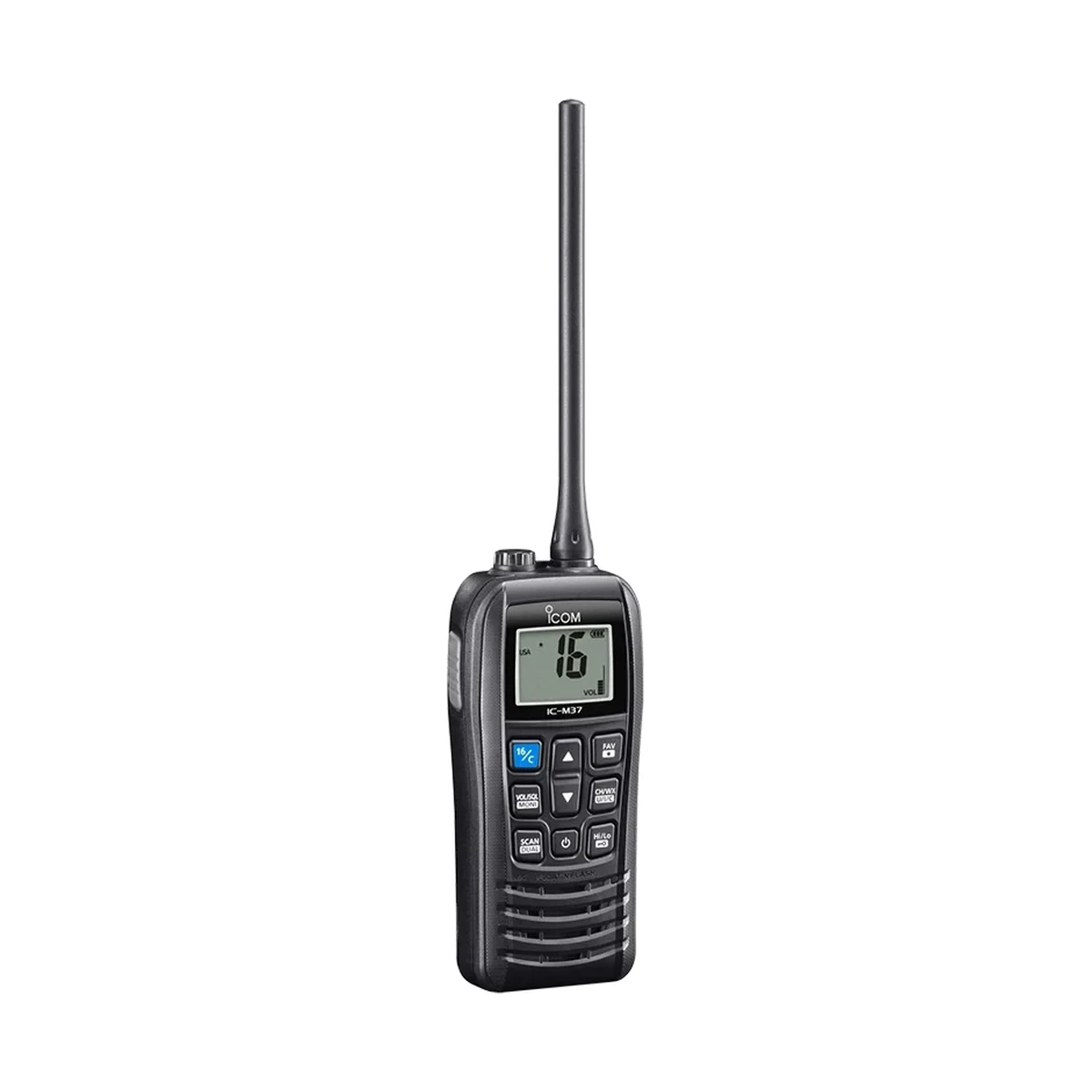
- The Icom IC-M37 is rated IP57 for dust and water, withstanding one metre for 30 minutes, and carries Icom's Float'n Flash function so the radio floats and flashes if it goes over the side. It delivers 6 W of RF output and more than 12 hours of operating time on the supplied BP-296 pack.
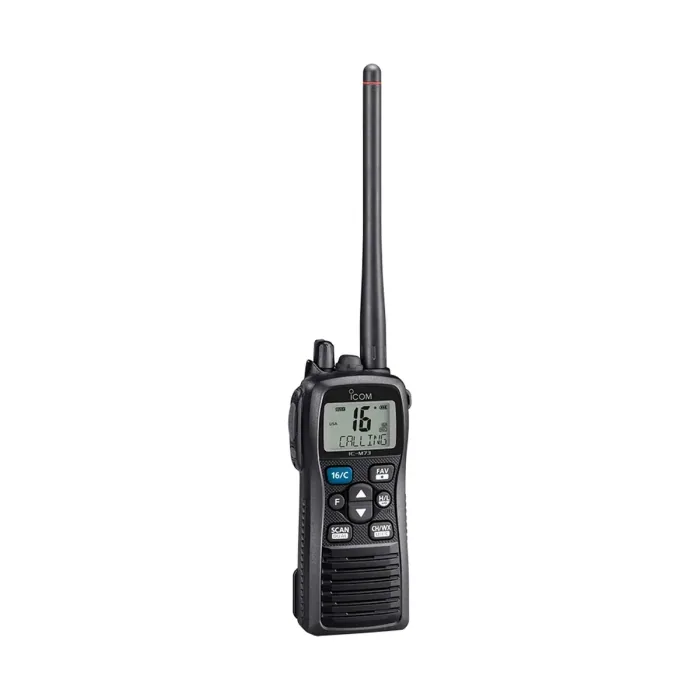
- The Icom IC-M73PLUS is built to IPX8, capable of submersion beyond the standard IPX7 specification, with selectable 6 W, 3 W and 1 W output and 700 mW of internal speaker audio. It weighs 320 g with battery, antenna and clip.
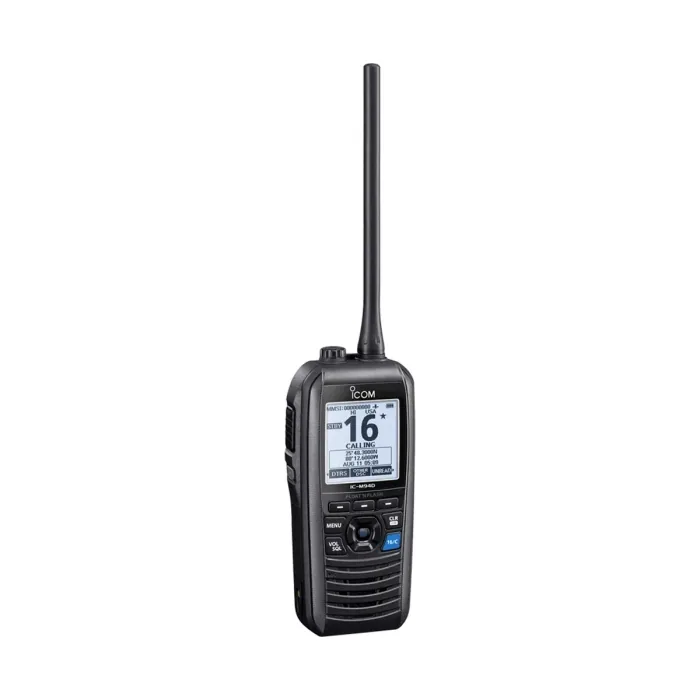
- The Icom IC-M94D is rated IPX7 and adds functions rather than sealing: built in DSC plus an AIS receiver on 162.025 MHz, so the handheld can raise a DSC alert and show nearby AIS traffic. It runs 6 W or 1 W and weighs 357 g.
- The Icom IC-M25EVO is the light option at 228 g with antenna and clip fitted, with selectable 5 W, 2.5 W or 1 W output from a 3.7 V battery.
- The Entel HT644 is rated IP68 at two metres for four hours and built to MIL-STD-810C/D/E/F/G, transmitting 5 W high or 1 W low, with a 2200 mAh pack rated for 14.5 hours on a 5/5/90 duty cycle.
- The Entel HT649 is the GMDSS variant, covering 19 preset International, USA and Canadian channels at under 1 W ERP, running from a primary lithium metal battery rather than a rechargeable pack for 17.5 hours, to the same IP68 and MIL-STD standards.
- The Samyung STV-160 covers all current USA, International and Canadian channels plus 10 weather channels, with a 7.2 V 1350 mAh pack rated at around 8 hours on a 10 percent transmit duty cycle.
Waterproof, floating, or GMDSS
The three are separate requirements and it helps to decide which one is driving the purchase.
If the risk is losing the radio, floating matters most, and a set with a float and flash function is worth the size penalty that buoyancy costs. If the risk is the environment rather than the drop, a higher immersion rating and rugged construction is the better spend, which is where the IP68 and MIL-STD tested Entel sets sit. If the requirement is regulatory, neither of those decides it: a GMDSS survival craft radio is a specified item built to its own standard, which is why the Entel HT649 runs a primary lithium battery that holds charge in a locker for years, and why the Icom IC-GM1600 is built to IMO resolution MSC.149(77) with more than eight hours of operation even at -20 C.
Practical selection points
- Battery chemistry follows the role. A rechargeable pack suits daily working use; a primary lithium pack suits an emergency set that must work after long storage.
- Power output is less useful than antenna height. Six watts from a handheld at deck level still cannot see past the horizon.
- Weight is a real factor for crew who carry a radio all shift, and buoyancy and ruggedness both add grams.
- DSC on a handheld only works once the set carries the vessel's MMSI and has position data available to it.
- Check whether the model is current before specifying a fleet, since several popular handhelds have been discontinued by their manufacturers.
ASPL supplies marine VHF handhelds, fixed sets, AIS and GMDSS equipment across India, with in house repair, warranty replacement and a nationwide collection network so a failed radio does not sideline a boat.