
Almost every fishfinder sold today advertises CHIRP sonar, usually alongside a wattage figure and a list of frequencies. The terminology is worth understanding before you spend money, because CHIRP is not a brand feature or a display mode. It is a change in how the transducer is driven, and it affects what you can actually resolve underneath the boat.
What a conventional sounder does
A traditional echo sounder transmits a short burst of sound at one fixed frequency, say 200 kHz, then listens for the returning echoes and plots them as a depth trace. The strength and timing of each echo tell you how far away an object is and roughly how solid it is. The limitation is that all the transmitted energy sits at a single frequency, so the sounder has to choose between a long pulse (more energy, more range, poorer resolution) and a short pulse (better resolution, less energy, less range). Two fish holding close together, or a fish sitting just above the seabed, often come back as one blurred return.
What CHIRP changes
CHIRP stands for compressed high intensity radar pulse, a technique borrowed from radar. Instead of transmitting at one frequency, the sounder sweeps continuously across a band of frequencies during each transmission, for example from low to high across a defined range. Because the returning echo carries that same swept signature, the receiver can correlate what it hears against what it sent and work out exactly which part of the sweep each return came from. The practical result is that the sounder gets the energy of a long pulse and the resolution of a short one at the same time.
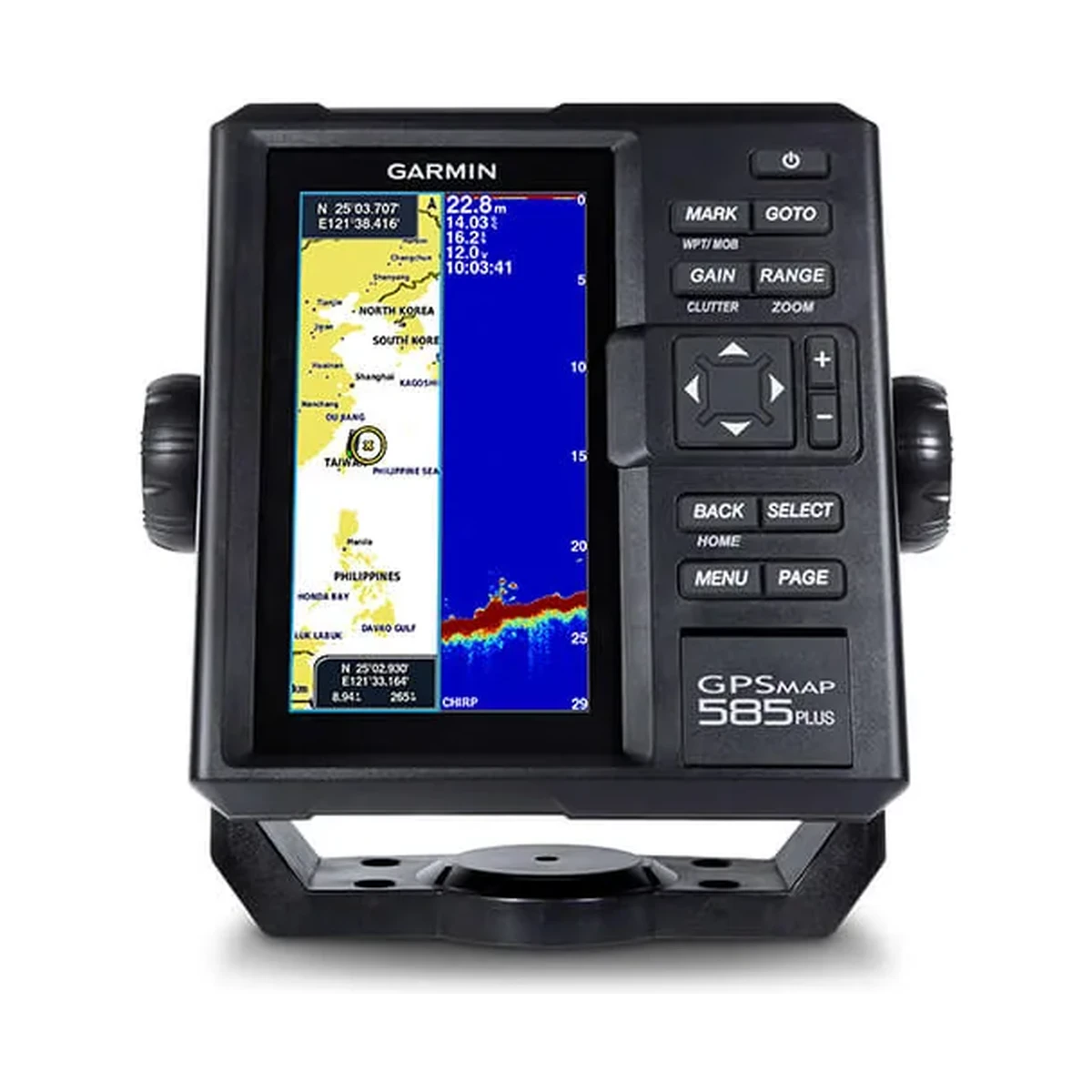
On screen this shows up in two ways. Individual fish separate into distinct arches rather than merging into a single blob, and structure close to the bottom stays distinguishable from the bottom itself. Garmin puts the same point plainly in its own description of the GPSMAP 585Plus, noting that a continuous sweep of frequencies from low to high produces crisper fish arches with better target separation.
Low, medium and high CHIRP
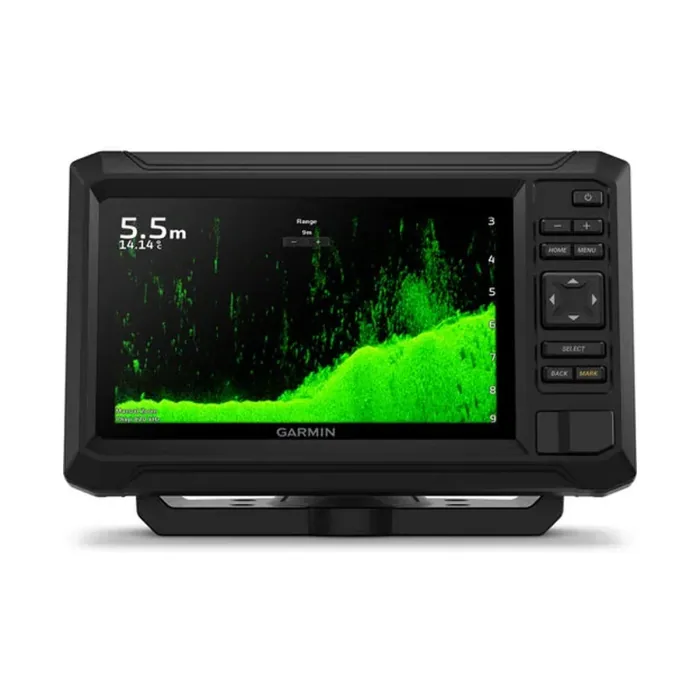
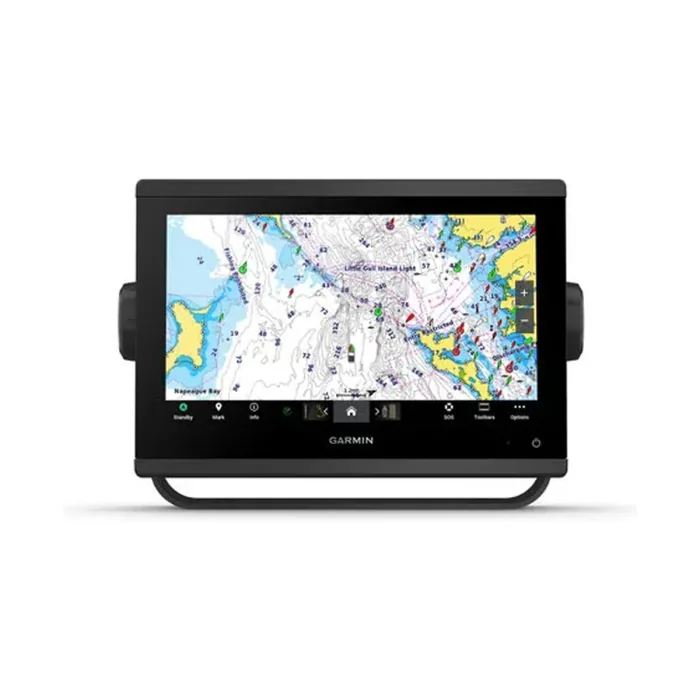
CHIRP sounders are usually specified by which bands they can sweep. Garmin's traditional CHIRP units list L, M and H CHIRP, mapped onto nominal frequencies. The ECHOMAP UHD2 7 inch cv sweeps around 50, 77, 83 and 200 kHz in low, medium and high CHIRP; the GPSMAP 923xsv works around 70, 83 and 200 kHz. The physics behind the choice does not change between models. Lower frequencies travel further and penetrate deeper water but cover a wider cone with less fine detail, while higher frequencies give tighter, more detailed returns over a shorter range. Deep water and offshore work favour the low band, shallow inshore fishing favours the high band, and most units let you run both and compare.
Scanning sonar is a separate thing
Alongside traditional CHIRP, most modern combos carry a high frequency scanning channel, marketed by Garmin as ClearVu for the view directly below the boat and SideVu for the view out to either side. These run far higher, typically 260 kHz up to 1200 kHz on units such as the ECHOMAP UHD2 7 inch cv and the GPSMAP 1223xsv, which is what produces the near-photographic image of wrecks, weed beds and rock. Scanning sonar is excellent for identifying structure and poor at showing fish arches at depth. It complements traditional CHIRP rather than replacing it, which is why the two are almost always fitted together.
Reading the power figure
Transmit power is quoted in watts RMS and tells you roughly how much acoustic energy the unit can put into the water, which sets the practical depth ceiling. The GPSMAP 585Plus runs 600 W, the ECHOMAP UHD2 7 inch cv runs 500 W, and helm-sized multi-function displays such as the GPSMAP 923xsv and GPSMAP 1223xsv carry a 1 kW sonar module. A higher figure is only useful if the transducer and the water depth justify it. For inshore and shallow coastal work a 500 W unit is not the limiting factor; for deep offshore fishing it will be.
What actually determines your picture
Two things matter more than the specification sheet. The first is the transducer: it has to be rated for the frequency bands the head unit transmits, and mounted where it stays in clean, unaerated water at the speeds you fish at. A capable CHIRP sounder fed by a badly sited transducer will produce a worse picture than a basic unit mounted well. The second is that you have to learn to read your own screen, on your own grounds, at your own depths. CHIRP gives you more information to interpret, not an automatic answer.
ASPL supplies fishfinder and chartplotter combinations across the range, sized for boats from small craft up to deep-sea trawlers, and has been a supplier under government fisheries schemes in India.