
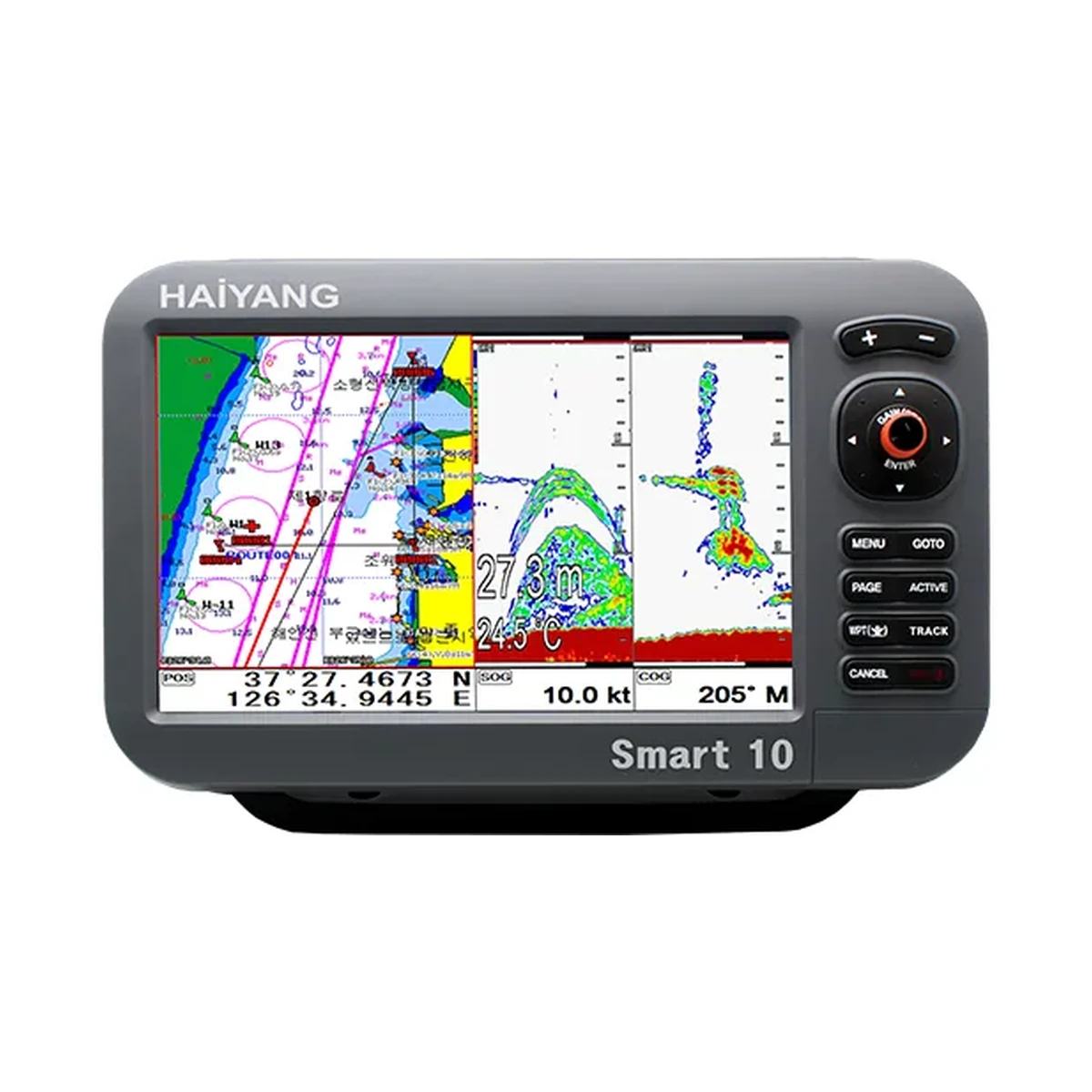
A fishfinder is two pieces of equipment that happen to be sold together. The head unit does the processing and the plotting, and the transducer, bolted to or through the hull, does the actual sounding. Almost every complaint about a sounder that reads poorly at speed, loses bottom lock in a turn or shows a fuzzy return in deep water comes back to the transducer: the type fitted, where it sits on the hull, and whether it suits the boat it is on. It is worth understanding the choices before the head unit is chosen, not after.
What a transducer actually does
A transducer converts an electrical pulse from the sounder into a pressure wave in the water, then converts the returning echo back into an electrical signal. Its ceramic element has a resonant frequency, and that frequency governs the trade-off that shapes everything else. Lower frequencies, typically around 50 kHz on a commercial sounder, spread a wider cone, penetrate deeper and tolerate murky water, but resolve less detail. Higher frequencies, 200 kHz and above, give a narrower cone and much finer target separation over a shorter range. That is why dual-frequency sounders exist at all: the Haiyang HD-50CF, for instance, works at 50 and 200 kHz with a rated output of 600 W or 1.5 kW and a stated depth range from 2.5 m out to 1,500 m.
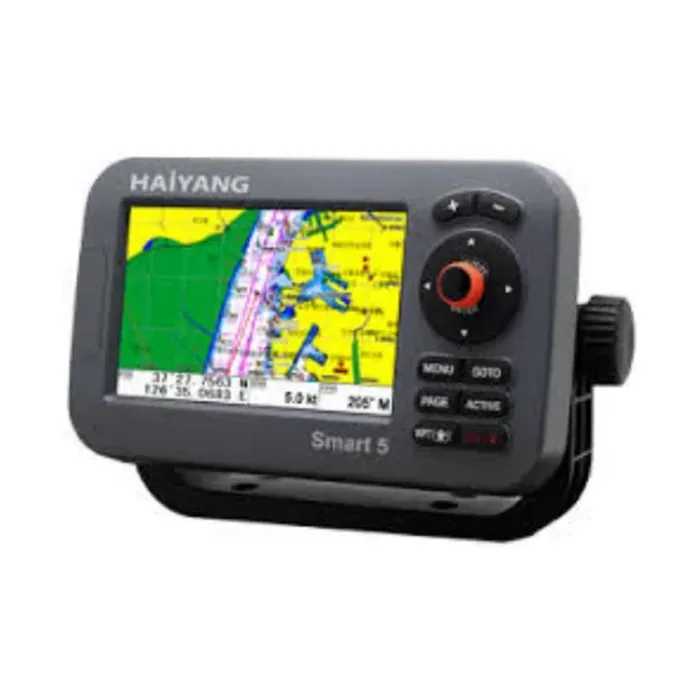
Transom-mount
A transom-mount transducer bolts to the outside of the transom, below the waterline, on an adjustable bracket. It is the easiest fit by a wide margin, needs no hole in the hull, and can be tilted after launch until the face sits parallel to the water. It suits planing powerboats and small craft with an unobstructed transom. Its weaknesses are all about water flow: mounted in the wake of a strake, a rivet line or an outboard leg, it picks up aerated water and the trace breaks up as soon as the boat is moving. It is also exposed to trailer damage and to anything the boat backs into.
Thru-hull
A thru-hull transducer passes through a drilled hole in the bottom of the hull and sits in clean, undisturbed water ahead of any turbulence. It is the reference standard for performance, particularly at speed and in deep water, and it is what commercial and larger vessels normally carry. The Haiyang HD 1000CF, for example, is listed as supplied with a stainless steel thru-hull transducer covering 200 and 50 kHz on a 10 metre cable. The costs are a hole below the waterline, the need for a fairing block on a deadrise hull so the transducer face points straight down, and the fact that a bronze thru-hull should not be fitted in an aluminium hull because of galvanic corrosion.
In-hull, also called shoot-through
An in-hull transducer is bonded inside a solid fibreglass hull and sounds through the laminate. There is no hole, no drag and nothing to damage, which makes it attractive on fast boats and on hulls the owner would rather not drill. The penalty is signal loss through the laminate, typically some reduction in maximum depth and sensitivity, and it will not work at all through a cored or sandwich-construction hull, or through metal or timber. It also cannot read water temperature accurately, since it never touches the water.
CHIRP against fixed-frequency
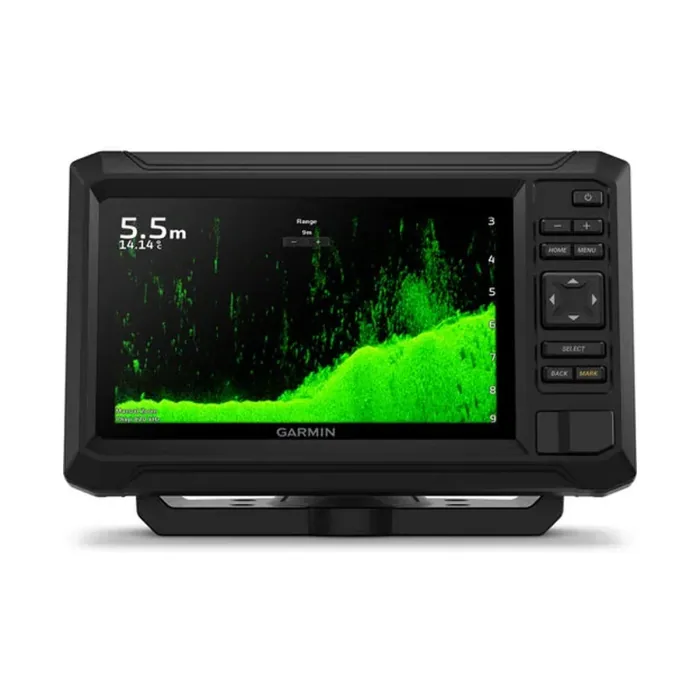
A conventional sounder transmits a pulse at a single frequency. A CHIRP sounder sweeps a continuous range of frequencies within each pulse, which puts more energy into the water without sacrificing resolution, and lets the receiver separate returns that a single-frequency set would merge into one blob. In practice that means better target separation and cleaner arches, especially over structure. Garmin's catalogue reflects this directly: the ECHOMAP UHD2 7" cv carries a built-in 500 W CHIRP sonar with traditional sounding at 50, 77, 83 and 200 kHz plus ClearVu scanning from 260 to 1200 kHz, while the GPSMAP 923xsv steps up to a built-in 1 kW CHIRP module with traditional, ClearVu and SideVu scanning. The important point is that CHIRP is a property of the sounder and the transducer together. A CHIRP-capable head unit fed by a transducer built for one fixed frequency will not deliver CHIRP performance.
Check what is in the box before you plan the install
ASPL supplies fishfinder and chartplotter combination units, not transducers as separate catalogue items, so the transducer question is settled by which combo you buy and what that model is supplied with. That varies:
- The Haiyang HD 1000CF is listed with a stainless steel thru-hull transducer, internal and external GPS antennas, bracket, power cable, dust cover and remote in the box.
- The Haiyang HD-50CF lists a transducer under options rather than as standard, alongside microSD and an external GPS antenna.
- Garmin's ECHOMAP UHD2 7" cv has a single 4-pin transducer port and the cv models are normally sold as a bundle with a transom-mount transducer, but the port count is what the spec sheet states, so confirm the exact bundle before ordering.
- The larger GPSMAP 923xsv and GPSMAP 1223xsv use a 12-pin transducer port to carry the higher-power CHIRP and scanning channels, which means the transducer has to be matched to that port, not adapted to it.
If in doubt, ask what transducer, what mounting style and what cable length are supplied with the specific part number before the boat is out of the water. Retrofitting a different mounting style afterwards is a far bigger job than getting it right at order time.