
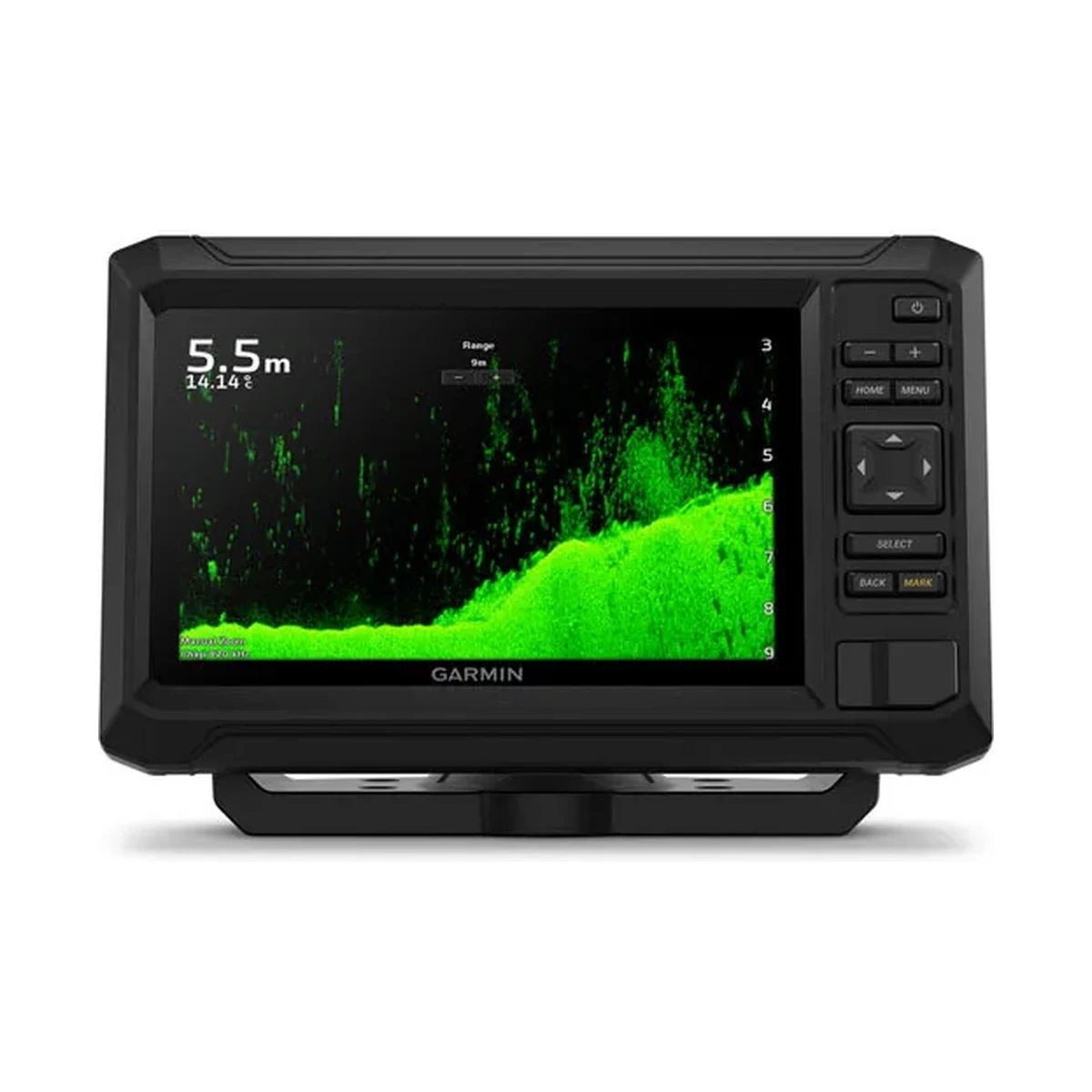
The single most useful thing a combined chartplotter and fishfinder does is show you both pictures at once. The chart tells you where you are and where the ground you are working sits in relation to everything else. The sonar tells you what is under the boat right now. Read together on one screen, they answer a question that neither answers alone: what does the bottom actually look like at this charted position. Garmin calls these combination pages, and on the ECHOMAP UHD2 they are configured from the home screen rather than being fixed layouts.
What the hardware is working with
Take the ECHOMAP UHD2 7" cv as the reference. It has a 6.1 by 3.4 inch WVGA display at 800 by 480 pixels, driven by keyed buttons rather than a touchscreen, in an IPX7 housing. Its receiver covers GPS and Galileo at 5 Hz with WAAS support. On the sonar side it carries a built-in 500 W CHIRP sounder offering traditional sounding at 50, 77, 83 and 200 kHz and ClearVu scanning at 260, 455, 800, 1000 and 1200 kHz, through a single 4-pin transducer port. Those numbers matter to how you read the screen, because the two sonar views come from different frequencies doing different jobs.
Reading the traditional CHIRP half
Traditional sonar scrolls right to left, with the newest returns at the right-hand edge and depth increasing downward. The solid line across the display is the bottom. A thicker, brighter bottom return generally indicates a harder bottom, since hard ground reflects more energy back, while a thin, weak return suggests soft mud that absorbs it. Targets between the surface and the bottom appear as arches, because the cone of sound reaches a fish before the boat is over it and keeps reaching it after passing, so the range shortens and then lengthens again. A full arch means the target passed through the centre of the cone; a half arch or a dash usually means it passed through the edge, or that the boat was stationary. Do not over-read the shapes. Arch quality depends on boat speed, cone angle and depth as much as on what the target is.
Reading the ClearVu half
ClearVu is a high-frequency scanning sonar working at 260 kHz and up, and it produces something closer to a photograph than a sonar trace. Its beam is very narrow fore and aft and wide across the boat, which is why structure such as rock ledges, wreckage and standing timber resolves so clearly, and why individual fish tend to appear as small dots or dashes rather than as arches. The two views are complementary rather than competing: traditional CHIRP is better at separating targets in the water column and reaching depth, ClearVu is better at showing you the shape of what is down there.
Split-frequency and split-zoom
Beyond the chart-and-sonar combination, the ECHOMAP UHD2 offers sonar views that split the sonar pane itself. A split-frequency view shows the returns from two different frequencies side by side, which is the direct way to compare what a low frequency and a high frequency each make of the same water. A split-zoom view shows the full-depth trace on one side and a magnified section, usually the bottom, on the other, which is how you separate a fish holding tight to the bottom from the bottom return itself. Both are worth learning, because they use the display area for the specific question you are asking rather than showing everything at once.
What a small screen costs you
This is the honest limitation of a compact unit. Split a 800 by 480 display in two and each pane has roughly 400 pixels of width. That is enough to work with, but detail and the amount of chart context you can hold on screen both suffer, and on a keyed unit you will be switching between full-screen and split layouts more often than a larger display would need to. It is a reasonable trade on a small boat where panel space is the binding constraint.
When to size up
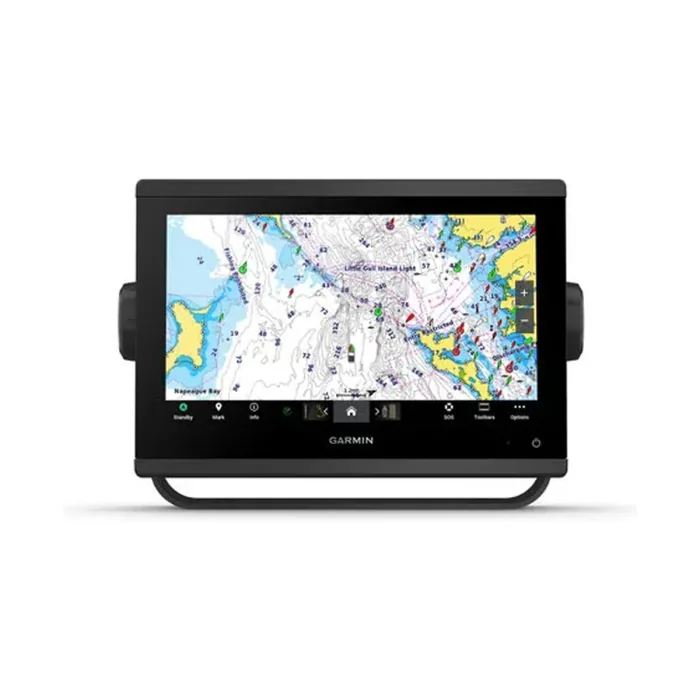
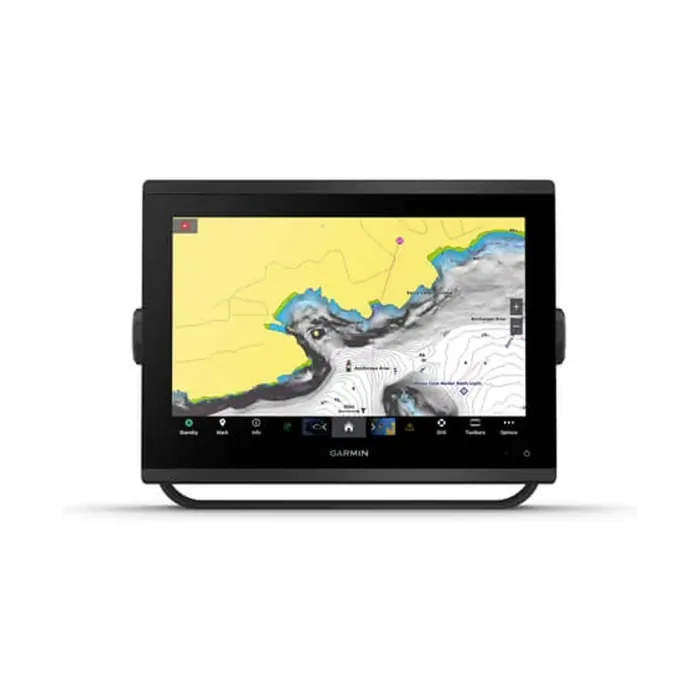
If the boat can carry a larger display and the work justifies it, the GPSMAP series changes what the split screen can hold. The GPSMAP 923xsv is a 9 inch touchscreen at 1280 by 720 with a built-in 1 kW CHIRP module adding SideVu alongside traditional and ClearVu, a 10 Hz receiver, and NMEA 2000, NMEA 0183, radar and Garmin Marine Network connectivity. The GPSMAP 1223xsv takes that to a 12.1 inch screen at 1280 by 800 and adds HDMI video output. With SideVu in the mix there is a genuine third view to place, and the extra pixels stop being a luxury.
- Build the combination page around the question you are actually asking, not around fitting everything on screen.
- Use split-zoom when you are working the bottom, split-frequency when you are unsure what a return is.
- Match the transducer to the head unit's port and frequencies, since the views above are only as good as what the transducer delivers.