
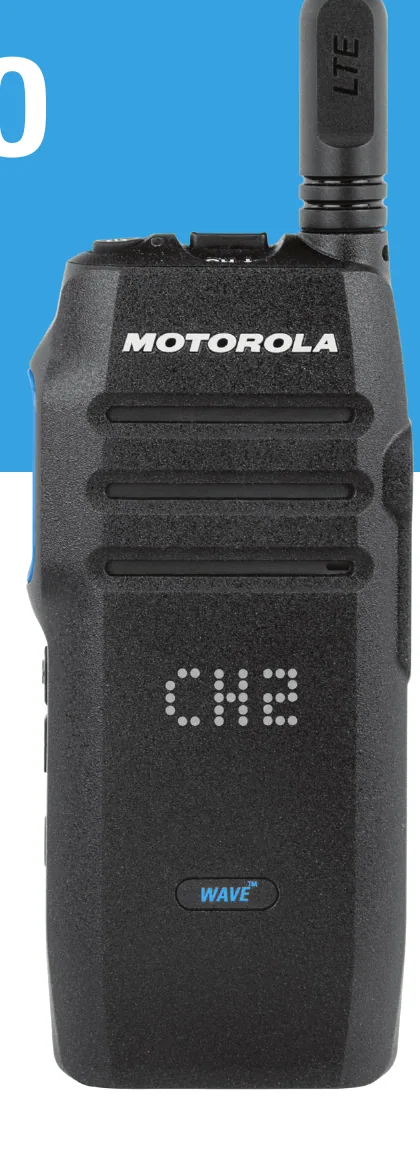
A fundamentally different technology
Every radio covered elsewhere in this series, from Icom's analog handhelds to Motorola's DMR range, transmits and receives over VHF or UHF radio spectrum, licensed or license-free, with range and coverage governed by the physics of that spectrum: line of sight, antenna height, terrain. The Motorola TLK-100 works on a completely different principle. It is a Push-to-Talk over Cellular device, carrying voice over 4G LTE mobile data through an embedded SIM, running on Motorola's WAVE platform rather than on radio spectrum at all.
What this changes about coverage
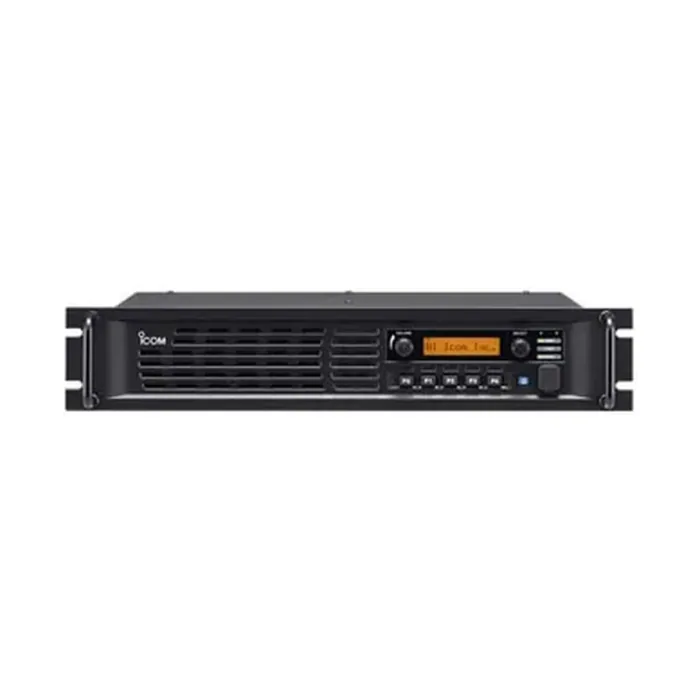
A conventional two-way radio's range is fixed by physics and by whatever repeater infrastructure a site has built. A PoC device's effective range is instead whatever the cellular network's coverage extends to, which for a modern LTE network can mean effectively nationwide or even global communication between users, something no conventional VHF or UHF system could match without an extensive network of linked repeaters. The trade-off is that the TLK-100 depends entirely on cellular coverage; in a location with no signal, a basement, a remote site, deep inside a steel structure, a conventional radio with a repeater in range will often still work where a PoC device cannot.
What the TLK-100 specifically offers
The unit supports up to 8 channels, expandable to 96, a 300-contact list, and GNSS location tracking across GPS, GLONASS, Galileo and BeiDou for genuinely global position reporting. Bluetooth and Wi-Fi connectivity extend it beyond the cellular link itself, and AES-256 encryption is built in as standard. Battery life is rated at 18 hours under a 5:5:90 duty cycle, transmit, receive, standby, and it carries an IP54 rating for dust and water resistance, a more modest ingress protection figure than some of the IP67 and IP68-rated conventional handhelds covered elsewhere in this series.
Where PoC genuinely makes sense
A PoC device earns its place where an operation is spread across a wide geographic area no repeater network could practically cover, multiple sites in different cities, a distributed field service team, or delivery and logistics staff who need to reach dispatch from anywhere the cellular network reaches rather than only from within a fixed site's radio coverage. It also suits operations that already lean on smartphone-based coordination and want push-to-talk voice integrated into that same digital workflow rather than maintaining a completely separate radio system.
Where a conventional radio remains the better choice
Any site where cellular coverage is unreliable, a warehouse basement, a remote industrial facility, a ship, an aircraft hangar with heavy structure, remains better served by a conventional VHF or UHF radio system, ideally with a repeater, since that system's coverage does not depend on a third-party cellular network's availability at all. Sites requiring the lowest possible latency and the most predictable, self-contained communication path, particularly safety-critical operations, also generally favour conventional radio, since a PoC device's voice path traverses considerably more infrastructure, the cellular network, the WAVE platform's servers, than a direct radio-to-radio or radio-to-repeater-to-radio transmission does.
Deciding between the two
- Single site or a few nearby sites with a repeater already covering them, or plausible to install: conventional VHF/UHF radio remains the simpler, more self-contained choice.
- Widely distributed operation, multiple cities, field staff constantly on the move outside any fixed coverage area: a PoC device like the TLK-100 solves a coverage problem conventional radio genuinely cannot.
- Safety-critical communication with zero tolerance for depending on external network infrastructure: conventional radio, ideally with independent repeater coverage, is the more robust choice.
- Already running smartphone-based operational tools and wanting integrated push-to-talk: the TLK-100's WAVE platform integration is a genuine fit.
ASPL supplies both conventional VHF/UHF two-way radio and can advise on where a broadband PoC device like the TLK-100 genuinely solves a coverage problem your existing radio infrastructure cannot.