
Buying a marine VHF radio is the easy part. Putting it into service in India involves a licence for the station, an identity for the vessel, and a short but unforgiving setup procedure on the radio itself. Owners tend to discover the second and third items after the set is already on the bracket.
The station licence and the identity are two different things
A vessel that carries transmitting radio equipment needs a radio station licence. In India the Maritime Mobile Station Licence is issued by the regional licensing offices of the Wireless Planning and Coordination (WPC) Wing of the Department of Telecommunications, with applications made through the government's online portal. A separate licence category exists for fishing trawlers and boats, which recognises that a working fishing boat has different documentation available to it than a registered merchant ship.
The identity is the MMSI, the nine digit Maritime Mobile Service Identity that a DSC radio transmits with every alert. Indian vessels use the 419 maritime identification digits. Obtaining an MMSI and call sign runs through the ship registration route, and the station licence documentation expects that allotment to be in hand, which is why the identity is generally sorted before the licence application rather than after. Our post on MMSI numbers and how to register one in India covers the identity side in more detail; this one deals with the radio.
Fees, validity periods and the exact document list are set by the licensing authority and change over time, so confirm the current requirements with the WPC regional licensing office before filing rather than relying on any summary, including this one. If your vessel is subject to survey, the radio side is also tied to its safety radio certification, which is a separate matter from the station licence.
What DSC needs in order to work
Digital selective calling is the reason the MMSI matters on a VHF set rather than just an AIS unit. Press the distress button on a DSC radio and it sends a data burst on channel 70, at 156.525 MHz, carrying the vessel's identity and, if the radio has position data, its position. Coast stations and nearby vessels decode it automatically. Without an MMSI entered, a DSC radio cannot originate that alert at all.
Two things therefore have to be true before the radio is useful in an emergency.
- The correct MMSI is programmed in. On many sets this is a one time entry that locks afterwards, so a mistyped digit is not trivially fixed and usually means going back to the dealer or manufacturer.
- The radio has position data. Either it has its own GNSS receiver, as the Icom IC-M424G does with its internal 66 channel GPS, or it is fed position over NMEA from the vessel's navigation system. A DSC alert without a position is far less useful to a rescue coordinator.
Choosing a DSC capable set
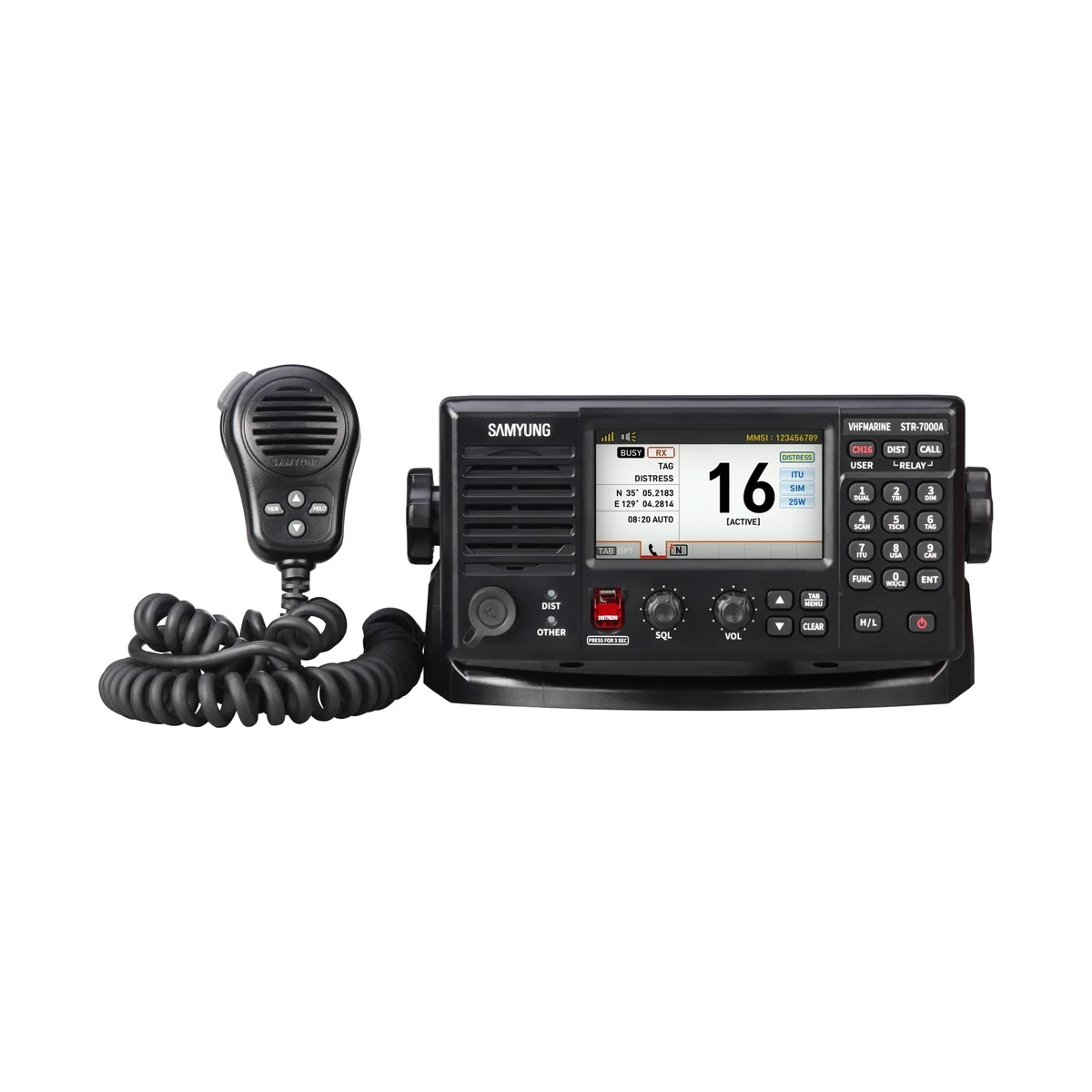
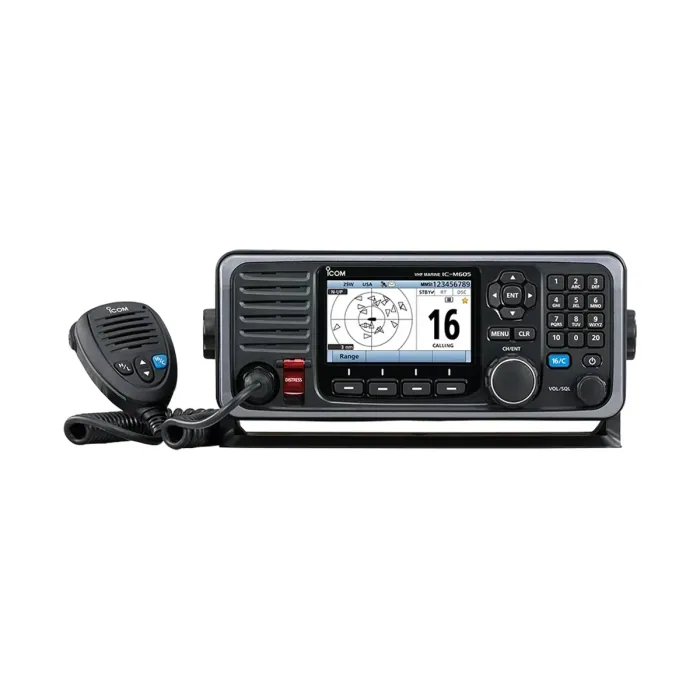
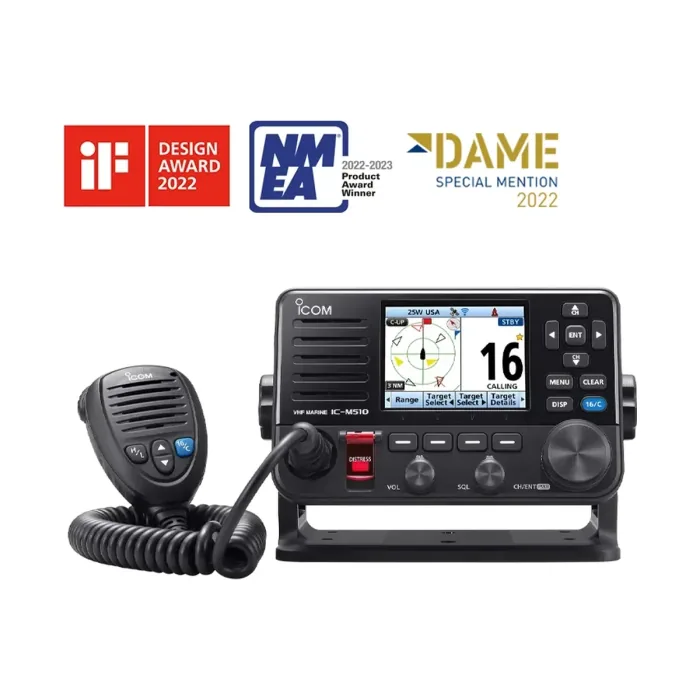
Fixed mount sets are where DSC belongs, because a masthead antenna and 25 W of output give the range a handheld cannot. The Samyung STR-7000A runs ITU-R M.493-14 Class A DSC with a dedicated 156.525 MHz watch keeping receiver, 191 channels and selectable 25 W or 1 W output. The Icom IC-M605 and IC-M510 Class D pair DSC with dual channel AIS receive on 161.975 and 162.025 MHz, so nearby traffic appears without a separate receiver. Where GMDSS carriage applies, the requirement is met by purpose built equipment such as the Icom GM600, a GMDSS VHF radiotelephone with Class A DSC.
Handheld DSC sets exist too, and the Icom IC-M94D combines DSC with an AIS receiver in a handheld body, but they are a supplement to a properly installed fixed station rather than a replacement for one.
Commissioning the radio properly
Once licensed, the setup that matters is short. Enter the MMSI carefully and verify it back before committing. Confirm that position data is reaching the radio, not merely that a GPS exists somewhere on the boat. Check that the DSC watch receiver is enabled and that channel 16 dual or tri watch is configured the way the crew expects. Make sure the antenna and its feeder are sound, because a DSC alert is only as good as the signal that leaves the vessel. And keep the licence documentation and the MMSI allotment on board, since they are what an inspection will ask for.
ASPL supplies, installs, commissions and services marine VHF, AIS and GMDSS equipment for commercial vessels, fishing fleets and workboats across India, including NMEA interfacing between the radio, GNSS and chartplotter, and operator training for bridge crew at handover. Licensing itself rests with the vessel owner and the issuing authorities, but getting the equipment configured and interfaced correctly once the number is in hand is work we can take on.