
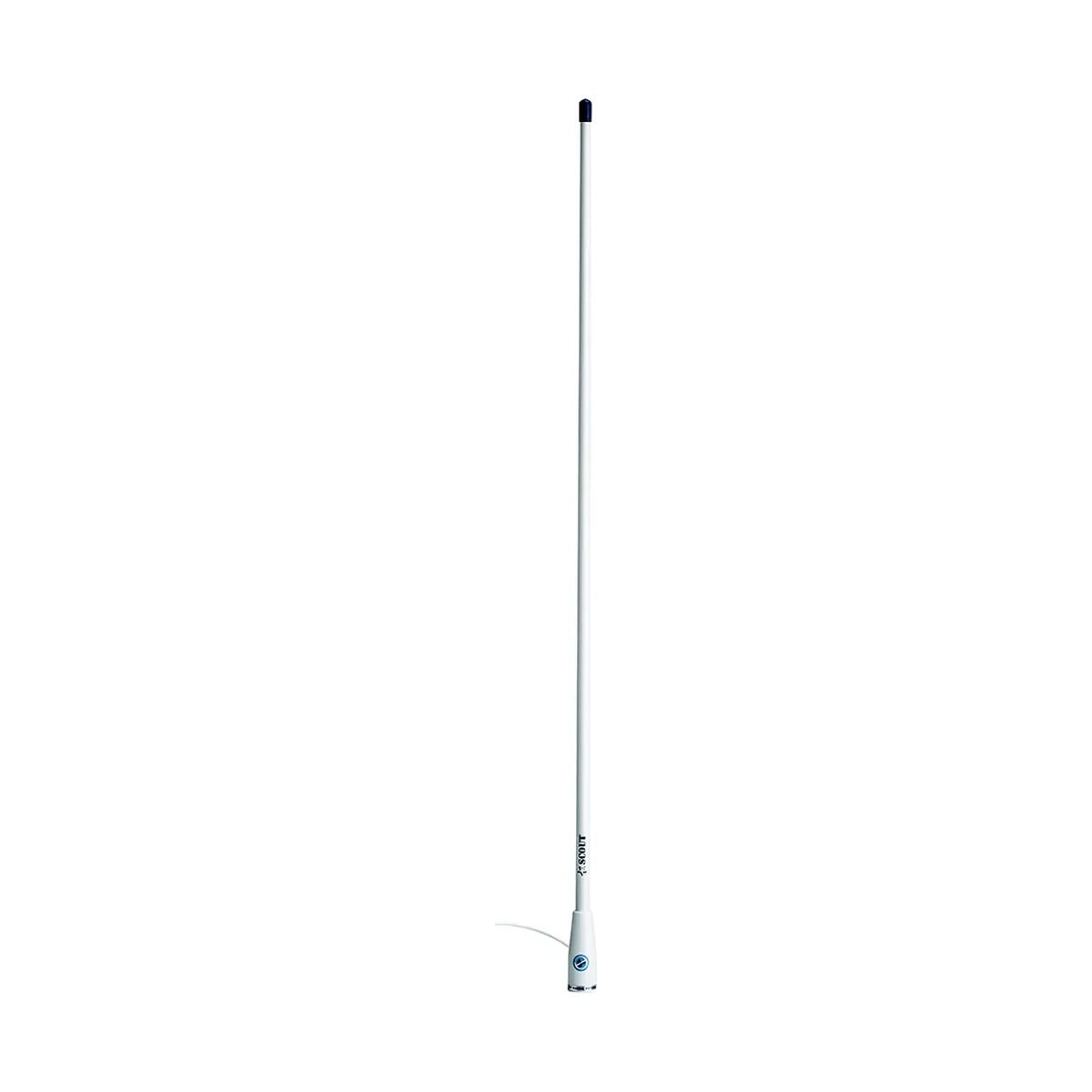
VHF range is a geometry problem
Marine VHF sits at around 156 to 163 MHz, and signals at those frequencies travel essentially in straight lines. They do not follow the curvature of the earth the way medium-frequency signals do, and they do not bounce off the ionosphere the way HF does. That is precisely why VHF is used for short-range working traffic and MF/HF is used for long-range distress and safety work.
The consequence is that VHF range is not really a radio question at all. It is a question of whether the two antennas can see each other over the curve of the earth. Everything else, power included, only affects whether a signal that is geometrically possible is also strong enough to be understood.
The arithmetic of the radio horizon
The usual working approximation for the radio horizon in nautical miles is 1.23 multiplied by the square root of the antenna height in feet. Because both stations contribute, the maximum range between two stations is the sum of the two horizons. A few worked examples make the point:
- A handheld held at about 6 ft above the water: roughly 3 nautical miles of horizon.
- An antenna on a small open boat's console at 8 ft: roughly 3.5 nautical miles.
- A fishing boat with the antenna at 25 ft: roughly 6 nautical miles.
- A sailing yacht with a masthead antenna at 50 ft: roughly 8.7 nautical miles.
- A ship's bridge-top antenna at 100 ft: roughly 12.3 nautical miles.
Two handhelds at deck level are therefore working with about 6 or 7 nautical miles between them at best. A handheld talking to that ship at 100 ft has roughly 15 nautical miles available, and two ships with masthead antennas at 100 ft have around 25. Nothing in those numbers depends on the radio. Raise one antenna and the whole calculation improves; raise both and it improves twice.
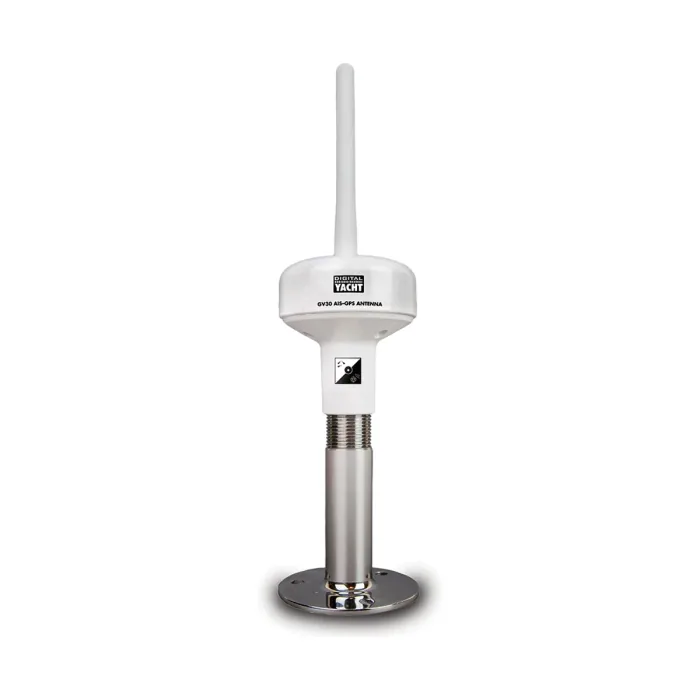
What transmit power actually buys
Power decides signal strength within the horizon, not the horizon itself. Doubling transmitter output raises the received signal by 3 dB, so the jump from 1 W to 25 W is a useful 14 dB and makes a genuine difference to readability at the edge of coverage, through noise, or with a partially obstructed path. What it cannot do is bend a signal over the horizon. Once the geometry has run out, extra watts change nothing, which is why a 6 W handheld and a 25 W fixed set at the same antenna height reach broadly similar distances even though one is four times the power.
This is also why the 1 W low-power setting on every marine set exists and should be used more than it is. Within a harbour or between boats in company, 1 W is entirely adequate and keeps the channel clear for everyone else within a 25 W radius.
The losses between the radio and the antenna
Height is free range; feeder loss is range thrown away. A long run of thin coaxial cable at VHF frequencies can absorb a substantial fraction of the transmitter output before it reaches the antenna, and the same loss applies to received signals coming back down. On any run longer than a few metres, and on every masthead installation, thicker low-loss coaxial cable pays for itself. Connectors matter as much as cable: a corroded or water-tracked connector at the base of a mast is one of the most common causes of a set that used to work and now does not.
Antenna gain interacts with the boat. A high-gain antenna concentrates energy into a flatter pattern, which suits a stable displacement vessel or a ship, but on a sailing yacht that heels, or a small planing boat in a seaway, that narrow pattern can point energy at the sky or the water exactly when it is needed. Lower-gain antennas with a broader pattern are usually the better choice on small, lively boats, and on sailing yachts the masthead position is doing far more work than the gain figure.
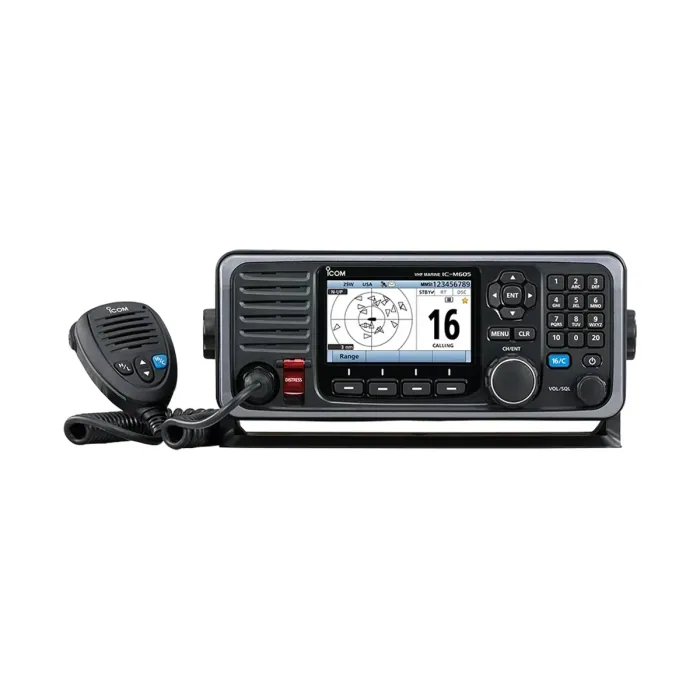
What this means when specifying a set
Decide the antenna position and cable run before choosing the radio. If the antenna cannot go high, accept that range is limited and design around it: AIS for situational awareness at greater distance, DSC so a distress alert reaches whatever station is within reach, and MF/HF or satellite equipment where the operation genuinely goes beyond VHF coverage. If the antenna can go high, spend the budget on the mount, the cable and the connectors rather than on a set with a bigger number on the box.
ASPL supplies marine VHF, AIS and antenna hardware and carries out bridge fit-out and interfacing, so the antenna plan and the radio choice can be settled together rather than one being fitted around the other.