
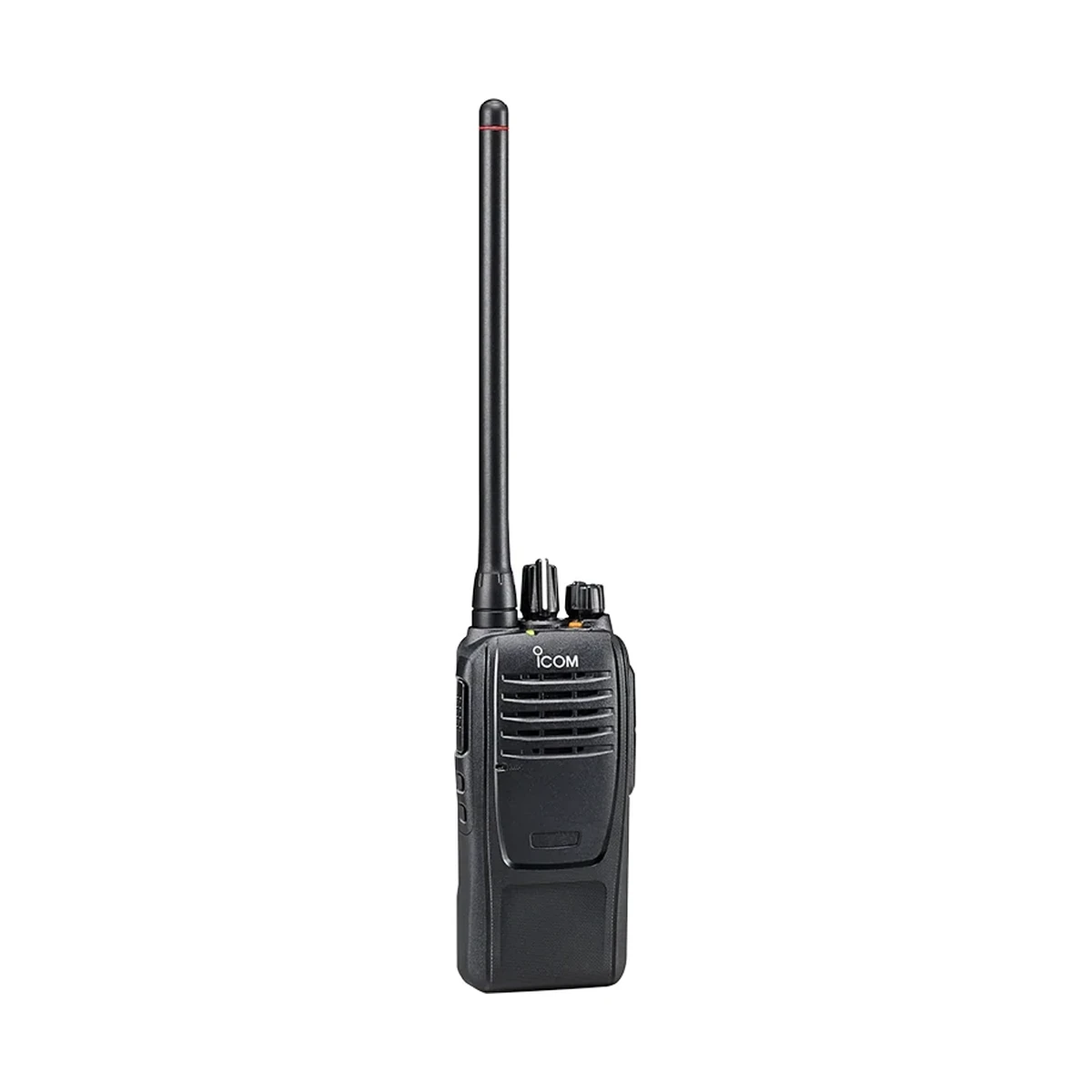
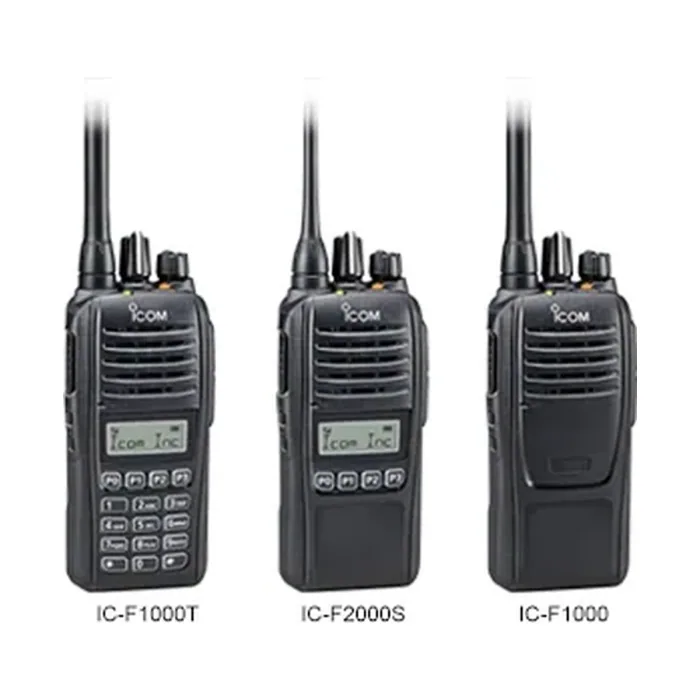
Icom's IC-F1000 (VHF) and IC-F2000 (UHF) sit at the accessible end of the company's commercial handheld range, analog, straightforward and built around class-leading audio output rather than an extensive feature list. The IC-F3400D and IC-F4400D occupy a similar physical footprint but step up to digital transmission, and the choice between the two pairs is really a choice about whether digital's added capability is worth its added cost for your operation.
What the IC-F1000/F2000 get right
Both radios deliver a genuinely loud 1500 mW of internal audio, useful on a noisy site where a quiet radio speaker is a real operational problem, and both offer 128 channels across 8 zones on the display variant, or a simpler 16-channel non-display version for users who need nothing more than a handful of fixed frequencies. A built-in motion and stationary detection sensor adds a lone-worker safety feature, triggering an alert if the radio detects no movement for a set period, a feature aimed squarely at solitary site work rather than group communication. At 240 to 270 grams depending on battery fitted, they are compact, unobtrusive handhelds suited to being carried all day.
What the IC-F3400D/F4400D add
The digital step brings individually addressed calling rather than open-channel broadcast, meaning a specific user or group can be called without every radio on the channel hearing it. Trunking support, NXDN Type-D or dPMR Mode 3, is available for sites that need it, along with multi-site connectivity and voting scan for larger deployments spanning more than one repeater. Over-the-Air-Programming lets a fleet be reconfigured remotely rather than requiring each radio to be connected to a PC individually, a genuinely significant time saving for a fleet of any size. Channel capacity scales up to 4000 channels across 128 zones as an option, against the IC-F1000/F2000's 128-channel ceiling, and the digital pair carries an IP68 dust-tight and waterproof rating, a step up from typical analog-tier ingress protection.
What stays similar
Both pairs cover the same general VHF (IC-F1000, IC-F3400D) and UHF (IC-F2000, IC-F4400D) bands, both are built to a similar rugged commercial standard, and both support Mix Mode operation on the digital units, meaning the IC-F3400D and IC-F4400D can run analog channels alongside digital ones rather than forcing an all-or-nothing switch.
Deciding which pair to buy
- Small team, straightforward point-to-point or group channel communication, cost-sensitive: the IC-F1000 or IC-F2000 deliver everything most small operations actually need.
- Larger fleet needing addressed calling, data messaging or a path to trunking as the operation grows: the IC-F3400D or IC-F4400D justify their higher cost with capability the analog pair cannot offer at any price.
- Operating in wet, dusty or otherwise harsh conditions: the digital pair's IP68 rating is a meaningful upgrade over typical analog ingress protection.
- Migrating an existing analog fleet gradually: the digital pair's Mix Mode support means new digital radios can be introduced without immediately retiring every analog unit still in service.
ASPL supplies both pairs in India and can help work out whether your operation's actual communication needs, not just its budget, point toward analog or digital.