
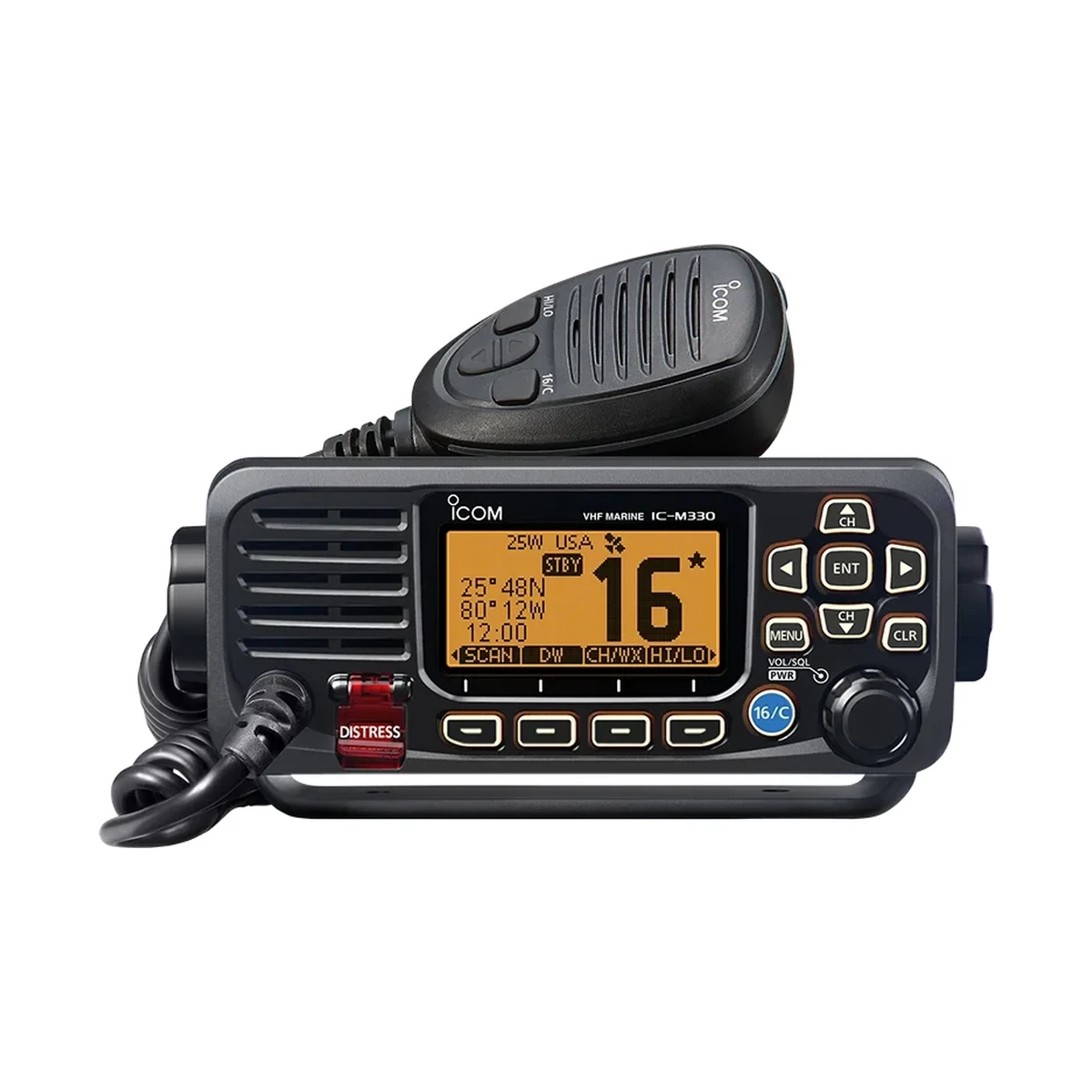
Owners tend to frame this as a budget question, and it is not. A fixed-mount VHF and a handheld VHF are built to do different jobs, and on most working vessels the honest answer is that you need both. What varies is which one is the primary installation and which is the backup, and that follows from how far offshore the boat works and what the crew has to do with the radio once they are there.
Transmit power and range
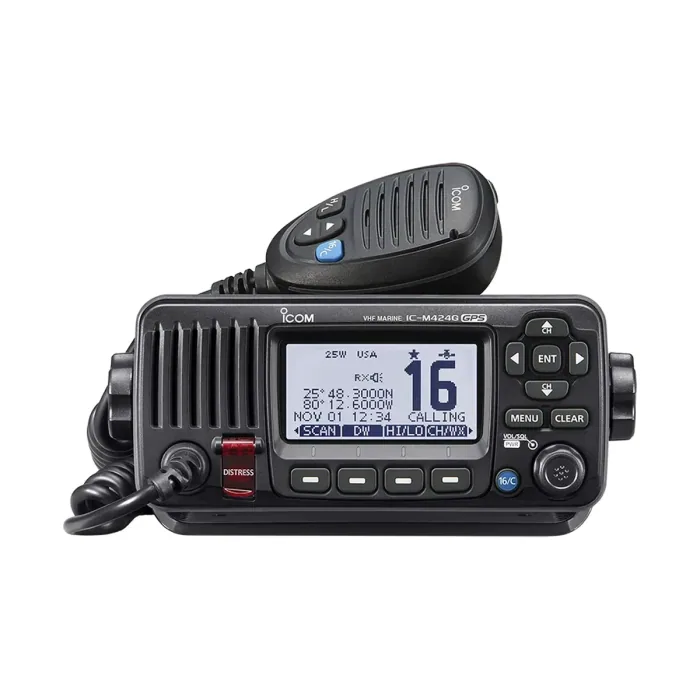
The single biggest difference is power. A fixed-mount marine VHF transmits at 25 W on high power. The Icom IC-M330, IC-M220 and IC-M424G are all specified at 25 W with a 1 W low setting. A handheld runs at a fraction of that: the Icom IC-M37 and IC-M94D put out 6 W high and 1 W low, the IC-M73PLUS offers 6, 3 and 1 W, and a GMDSS survival craft set such as the IC-GM1600 is deliberately limited to 2 W and 1.2 W because its job is short-range communication with a rescue unit that is already looking for you.
Power matters less than antenna height, though, and that is where the gap really opens. VHF is a line-of-sight service, so range is governed largely by how high the antenna sits above the water. A fixed set feeding a masthead whip through a 50 ohm coaxial run has an antenna several metres up. A handheld has a short rubber antenna held at chest height on a moving deck. Even at equal power the fixed installation would win, and it is not at equal power.
What a fixed set gives you that a handheld usually does not
- Continuous power. A fixed set runs off the vessel's 13.8 V DC supply and does not stop working when a battery pack runs down. Handheld endurance is measured in hours: the Entel HT644 is rated at 14.5 hours on a 5/5/90 duty cycle, and the Samyung STV-160 at eight hours.
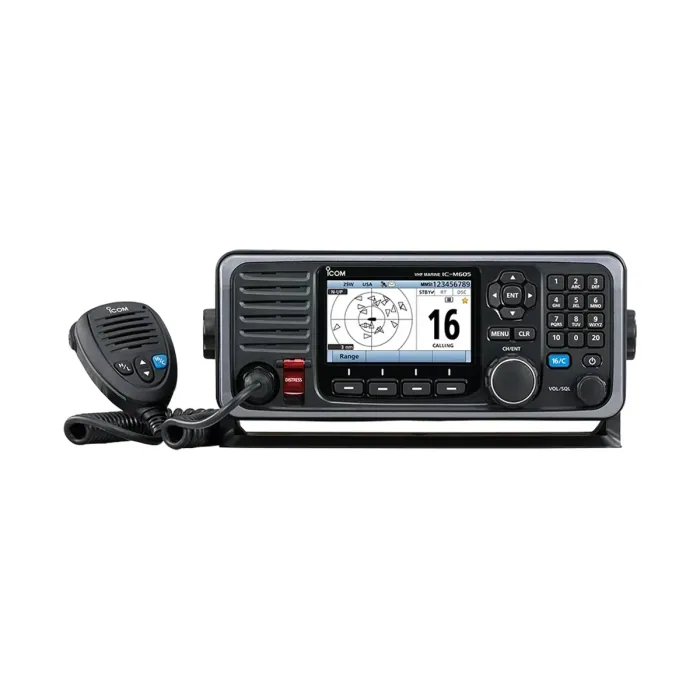
- DSC with a position source. Most fixed sets carry built-in Class D DSC and NMEA interfacing, and some, such as the IC-M424G, include an internal GPS receiver so a distress alert always carries a position. The IC-M605 and IC-M510EVO add dual-channel AIS receive on 161.975 and 162.025 MHz.
- Audio you can hear. Fixed sets drive larger speakers, and several add public address and foghorn outputs, which matters in an engine room draught or on an open bridge wing.
- Permanence. It is where the radio watch lives. Nobody has to remember to bring it.
What a handheld gives you that a fixed set cannot
A handheld goes where the crew goes. That covers deck work and mooring, a tender or workboat running between ship and shore, a fisher hauling gear at the rail, and the case the regulations care about most, abandoning ship. It also keeps working when the vessel's power does not, which is the entire reason survival craft VHF equipment exists as a separate carriage item.
Handhelds also carry ingress protection ratings a panel-mounted set does not need. The IC-M37, IC-M94D and IC-M73PLUS are rated IPX7 or IPX8, several Icom marine handhelds float and flash when dropped overboard, and the Entel HT644 and HT649 are rated IP68 at two metres depth for four hours with MIL-STD 810 construction. On a boat where the radio gets soaked and dropped as a matter of routine, that is not a luxury feature.
Choosing for the vessel you actually have
- SOLAS vessel: the question is settled for you. A type-approved GMDSS VHF installation such as the Icom GM600 is the primary set, and survival craft handhelds are carried in addition, not instead.
- Coastal commercial or fishing boat: a 25 W fixed set with DSC as the primary, plus at least one waterproof handheld for deck and tender work.
- Small open boat with no dependable 12 V system: a handheld may genuinely be the only practical set, in which case buy for battery endurance and waterproofing rather than for features.
- Hazardous cargo or tanker deck work: the choice narrows to intrinsically safe handhelds, and Entel's ATEX marine range and the Icom IC-M85UL exist for exactly that.
One practical note that applies either way: the fixed set is only as good as its antenna and its feed. A tired coaxial run or a corroded connector will cost more range than the difference between two models on a specification sheet, and it is far cheaper to fix.