
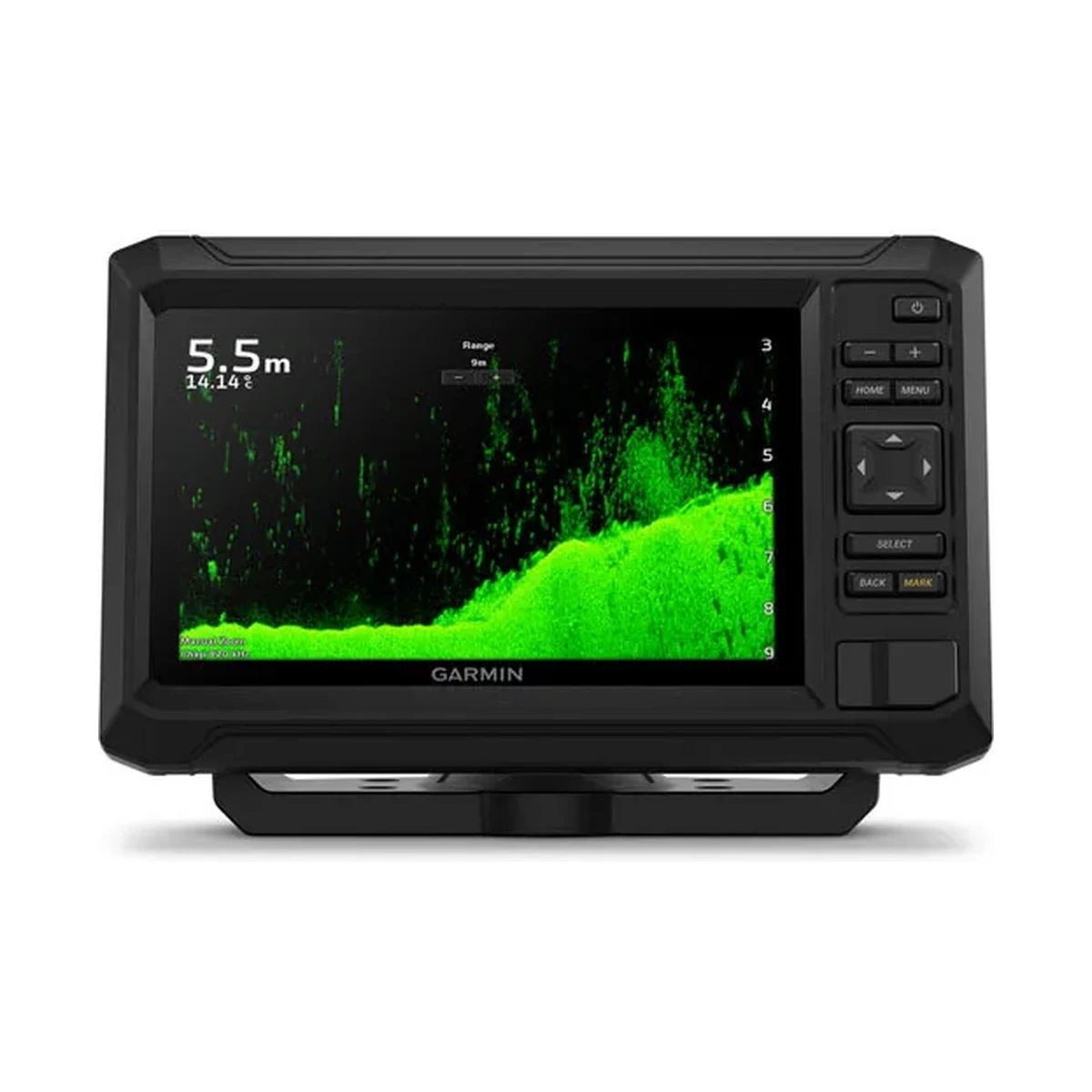
A chartplotter and a fishfinder answer two different questions. The chartplotter answers where the boat is and how to get back to somewhere it has already been, using a GNSS receiver and chart data. The fishfinder answers what is underneath the hull right now, using an echo sounder and a transducer. A combo unit puts both behind one screen. Whether that is the right choice for a particular boat has less to do with price than with how the boat is actually worked.
What each instrument does on its own
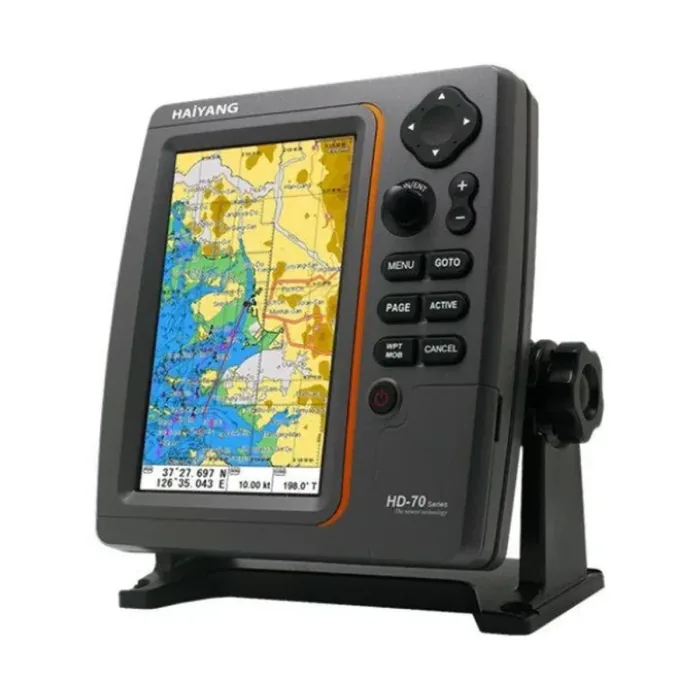
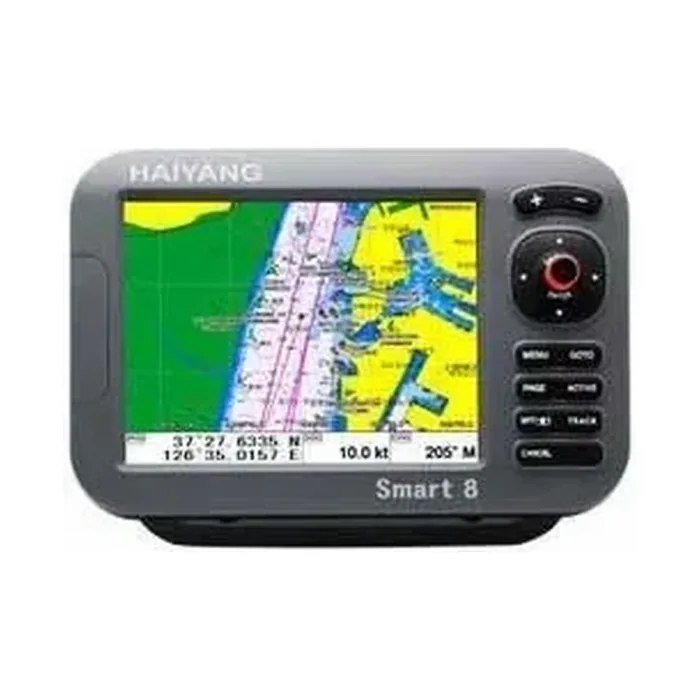
A dedicated chartplotter takes a position fix, places it on a chart and lets you build marks, tracks and routes around it. The Haiyang HD-70C and HD-880C are chartplotter-only units of this kind, a 7 inch and an 8 inch display respectively, each driven by a 52-plus channel GNSS receiver and each holding up to 100,000 waypoints, 50,000 track points and 100 routes against HY-MAP, C-MAP or Navionics chart data. Neither has a sounder inside it.
A dedicated fishfinder is the mirror image. The Haiyang HD-50F is a 5 inch sounder working at 50 and 200 kHz with 300 W or 600 W output, covering depths from 2.5 m out to 600 m, with normal, bottom-lock, bottom-zoom and A-scope display modes, three levels of interference rejection and four levels of noise rejection. It shows the water column in detail and knows nothing at all about where the boat is.
What a combo unit actually buys you
Putting the two functions in one box is more than a packaging convenience. The reason a combo earns its place on a working boat is that a mark can be dropped at the instant an echo appears, at the position the vessel occupied when that echo came back. Ground that produced fish once can then be returned to, and a track can be run back over the same line. On separate units, that association has to be made by the operator reading a position off one screen and typing it into the other, which is slow and error-prone in a seaway.
The Haiyang HD-50CF is the combo version of that same 5 inch platform: the same dual-frequency 50 and 200 kHz sounder, but rated at 600 W or 1.5 kW for depth coverage from 2.5 m to 1,500 m, and with the full multi-constellation GNSS receiver and 100,000-waypoint chart side alongside it. Garmin's ECHOMAP UHD2 7" cv takes a different route to the same idea, pairing a built-in GPS and Galileo receiver with a 500 W CHIRP sounder that adds ClearVu scanning at 260 to 1200 kHz for a more photographic picture of structure below the boat.
When two separate units are the better answer
- Redundancy. One combo unit is one failure away from losing both navigation and sounding at the same time. Two boxes fail independently.
- Simultaneous use. If the skipper is navigating while a crew member watches the sounder, a split screen on a small display serves neither well. Two full screens do.
- Mismatched requirements. A boat that needs deep-water sounding power but only a modest navigation display, or the reverse, can size each function separately instead of paying for both at the same tier.
- Staged purchase. Fitting the chartplotter now and the sounder later is straightforward with separate units and awkward with a combo.
Points to settle before deciding
Transducer choice matters more than the head unit for sounder performance. A 50 kHz element penetrates deeper with a wider cone, while 200 kHz gives better detail over a narrower one, which is why dual-frequency operation is standard on the Haiyang HD range. Check the depth range the sounder is rated to against the water you actually work, since the 300 W and 600 W ratings on the HD-50F cover 300 m and 600 m respectively while the 1.5 kW rating on the HD-50CF and HD-880CFA reaches 1,500 m.
Then consider screen area. A combo running a split screen gives each function roughly half the display, so an 8 inch combo such as the HD-880CFA is closer to two 5 inch instruments in usable area than to one 8 inch chartplotter. Finally, check chart data and interfacing: what chart format the unit reads, and whether it needs to exchange data with AIS, radar or an autopilot over NMEA 0183 or NMEA 2000.
ASPL supplies chartplotter and sounder combinations sized for boats from small craft to deep-sea trawlers, along with the bridge interfacing that ties them to the rest of the electronics. If the boat is a single-instrument fit, a combo is usually the sensible answer. If it is a wheelhouse with room for two screens and a crew to watch them, the argument for keeping the functions separate is a real one.