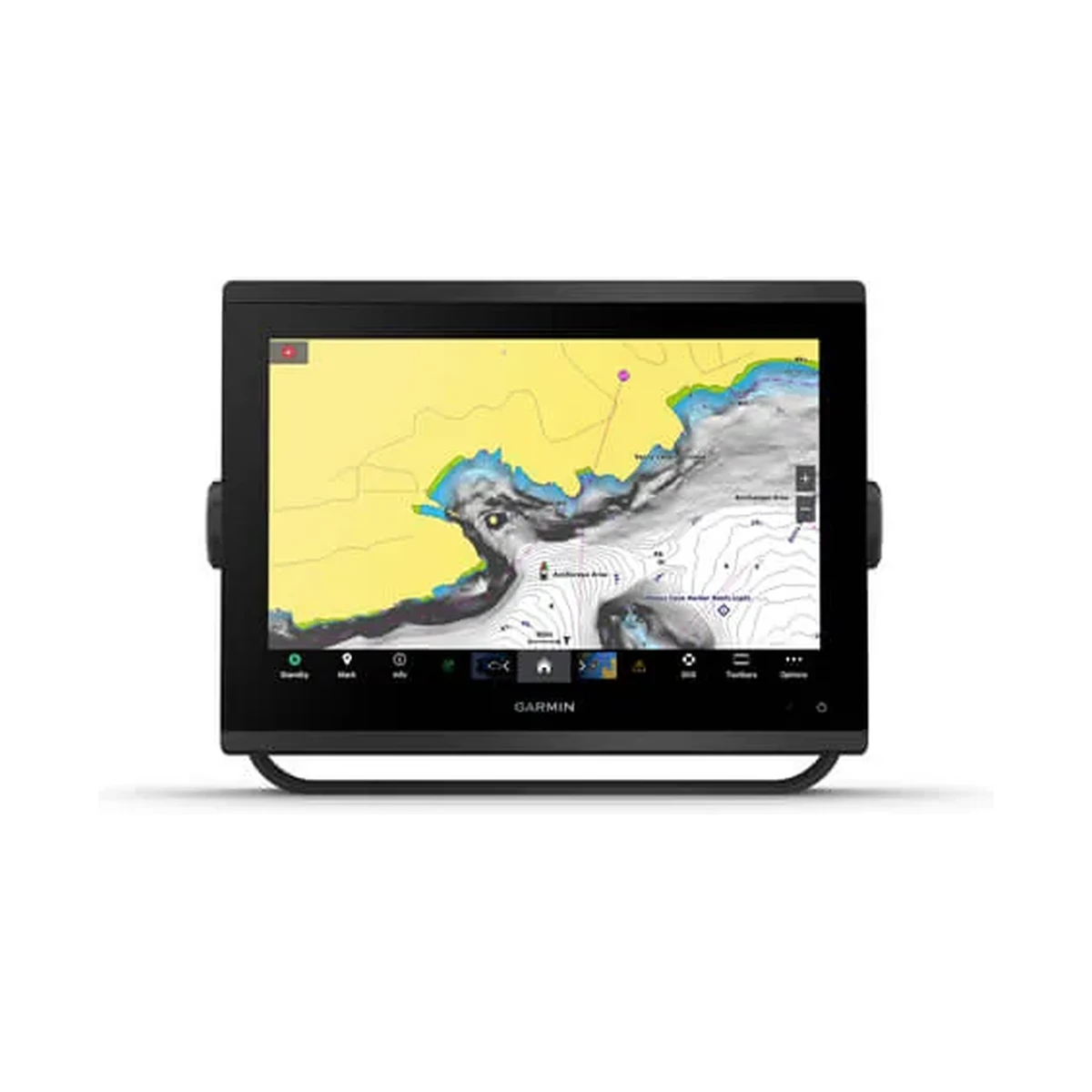
Put a modern multi-function display next to an ECDIS console and the family resemblance is obvious. Both show a chart, both plot own ship on it, both take position from GNSS and both can overlay radar and AIS targets. The difference is not really about screen size or processing power. It is that ECDIS is a defined, regulated system that can satisfy a ship's legal chart carriage requirement, and a chartplotter is a navigation aid that cannot.
What ECDIS actually is
ECDIS stands for Electronic Chart Display and Information System. It is defined by IMO performance standards and tested against an IEC type-approval standard, and a unit is only ECDIS if it is type-approved as such. That approval covers a long list of behaviours: how the system displays official chart data, how it handles chart updates, what alarms and indications it must raise, how it logs the voyage, and how it behaves when position input or chart data is lost. An approved system that is fed anything other than official chart data, or that has lost a required sensor, is required to indicate that it is operating in a degraded state.
The system also has to run on official Electronic Navigational Charts issued or authorised by a government hydrographic office, kept up to date through the official update service. This is the part that most clearly separates it from consumer equipment. Chart cartridges sold for leisure plotters are commercial products derived from official data, and they carry no equivalent legal status.
The carriage requirement
ECDIS became mandatory for defined classes of SOLAS ship through amendments to SOLAS Chapter V, Regulation 19, phased in by ship type and tonnage over a period running from 2012 to 2018. Broadly, it covered new passenger ships and tankers from 500 gross tonnage upwards and new cargo ships from 3,000 gross tonnage upwards, with existing ships brought in progressively by tonnage band at their surveys. Cargo ships other than tankers below 10,000 gross tonnage were not brought within the requirement. The exact date that applied to any individual ship depended on its type, tonnage, build date and survey schedule, so the position for a specific vessel should always be confirmed against the current convention text and the flag administration's guidance rather than taken from a summary.
Where ECDIS is used as the ship's primary means of navigation, the convention also requires adequate back-up arrangements. In practice that means either a second, independent approved ECDIS installation with its own power and position input, or a folio of up to date paper charts. Redundancy is part of the requirement, not an optional extra, and this is a substantial part of what an ECDIS installation costs.
Training and operation
ECDIS carries a training obligation that a chartplotter does not. Deck officers on ships fitted with it require generic ECDIS training and familiarisation with the specific type installed on their vessel, because each manufacturer implements the alarms, safety contour settings and route check functions differently. Misconfigured safety settings, particularly the safety contour and safety depth, have featured in more than one grounding investigation. The system will do what it is told, and telling it correctly is a taught skill.
What a consumer chartplotter does well
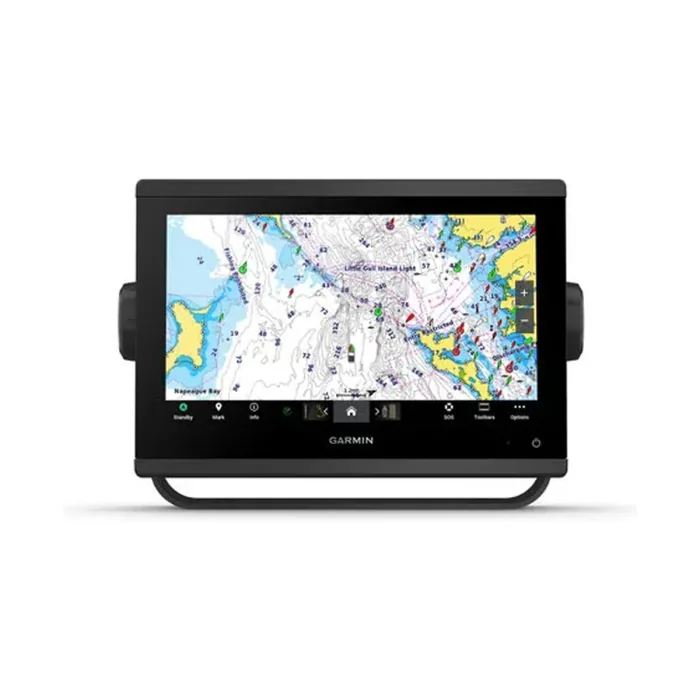
None of this makes a modern chartplotter a lesser instrument for the work it is built for. A helm multi-function display such as the Garmin GPSMAP 1223xsv gives a 12.1 inch touchscreen, multi-constellation GNSS at 10 Hz, built-in 1 kW CHIRP sonar with ClearVu and SideVu scanning, NMEA 2000 and NMEA 0183 connectivity, radar and AIS overlay, and networking to other displays. On a fishing boat, a workboat, a pilot launch or a yacht, that is a far more useful set of tools than a bare ECDIS console, and the vessel is under no obligation to carry ECDIS in the first place. Sonar, contour mapping and engine data are simply not what an ECDIS is for.
Choosing on the right grounds
The question is rarely which system is better. It is whether the vessel falls within the ECDIS carriage requirement. If it does, the ship needs approved equipment, official ENCs, an update service, back-up arrangements and trained officers, and nothing outside that framework will satisfy an inspection. If it does not, a chartplotter or multi-function display sized to the boat and the work is the appropriate tool, and the money is better spent on sonar capability, radar, AIS and a properly integrated network than on approval the vessel does not need.