
The short answer
Yes. An AIS receiver picks up the transmissions of every AIS equipped vessel within VHF range and passes them to a chartplotter, PC or tablet, without transmitting anything itself. Your own vessel stays invisible to other AIS users. No MMSI is needed, because you are never identifying yourself over the air, and no transmitting station licence question arises for the receiver itself.
How a receive-only unit works
AIS operates on two international VHF channels, 161.975 MHz and 162.025 MHz. A receiver tunes both, demodulates the position reports arriving from Class A and Class B transponders, AIS SARTs, base stations and aids to navigation, and outputs them as NMEA sentences. Because it has no transmitter, it is a simpler and cheaper device than a transponder, draws very little power, and has no static data to configure.
Sensitivity is the main performance number. The AMEC Cypho-150S and the R150GE WideLink both specify -112 dBm at 20 percent packet error rate across two channels. Single channel receivers exist and are cheaper still, but they time share between the two AIS channels and miss traffic while they are listening to the other one. A dual channel receiver is the sensible baseline.
What you give up
This is the part worth being honest about. A receiver gives you situational awareness. It does not give you visibility. The large vessel whose bridge team is watching an AIS display in a busy approach will not see you at all, and if their watchkeeping leans on AIS, your absence from it matters. Nothing about a receive-only setup is a substitute for a transponder on a vessel that is required to carry one, and on a small working boat operating in commercial traffic, the case for transmitting is usually stronger than the saving.
Where receive-only genuinely makes sense: leisure craft under no carriage requirement that want traffic on the chart, a second station on board that only needs a display feed, shore based monitoring at a marina, harbour office or fishing landing point, and any installation where the point is to observe rather than participate.
Choosing a receiver
The practical questions are how the data gets out and where it is going.
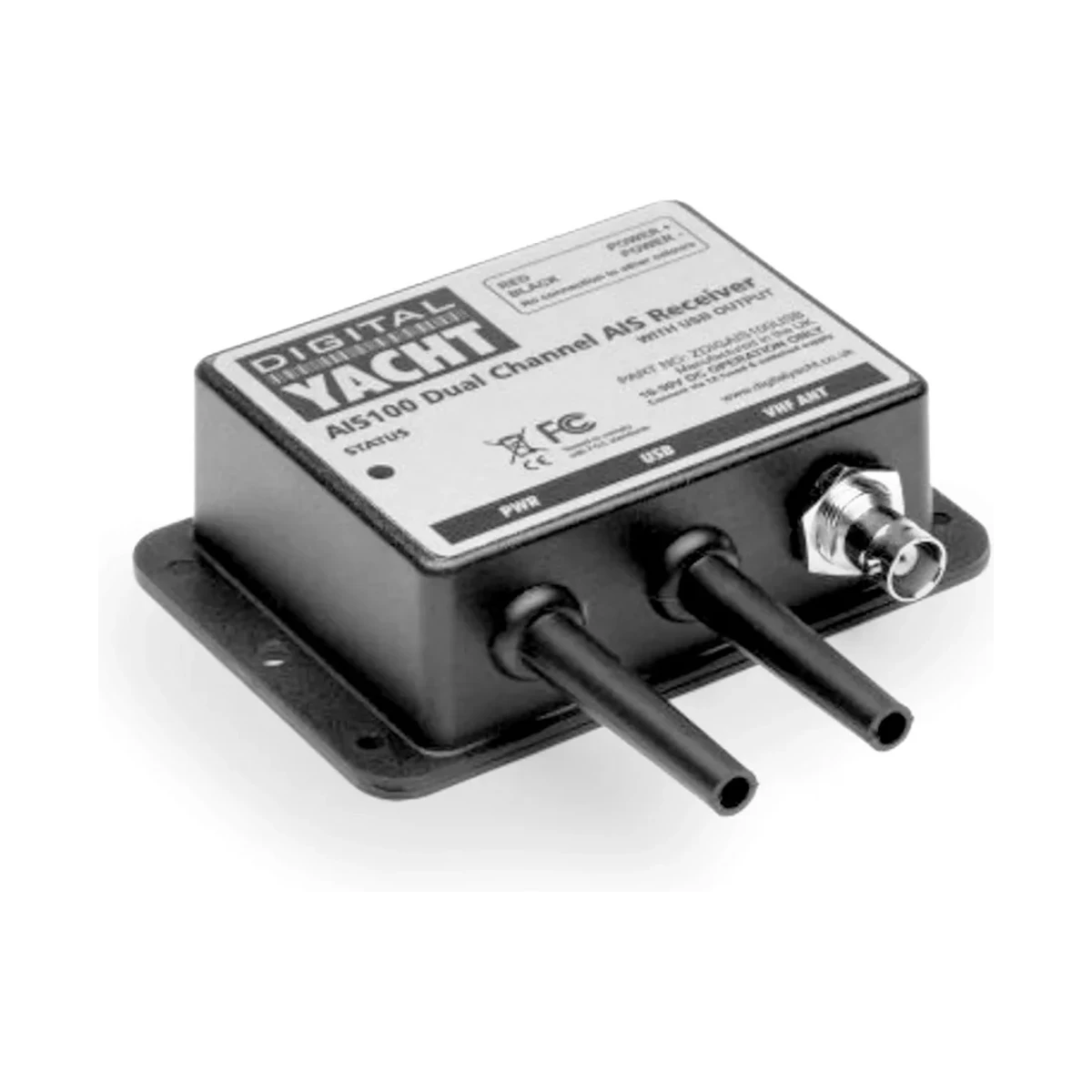
- USB to a PC. The Digital Yacht AIS100 Receiver (USB) is the entry point, a dual channel receiver that maps to a virtual COM port using drivers already built into Windows, and also works on macOS and Linux. Any AIS capable navigation software can read it, including Digital Yacht's own SmarterTrack Express.
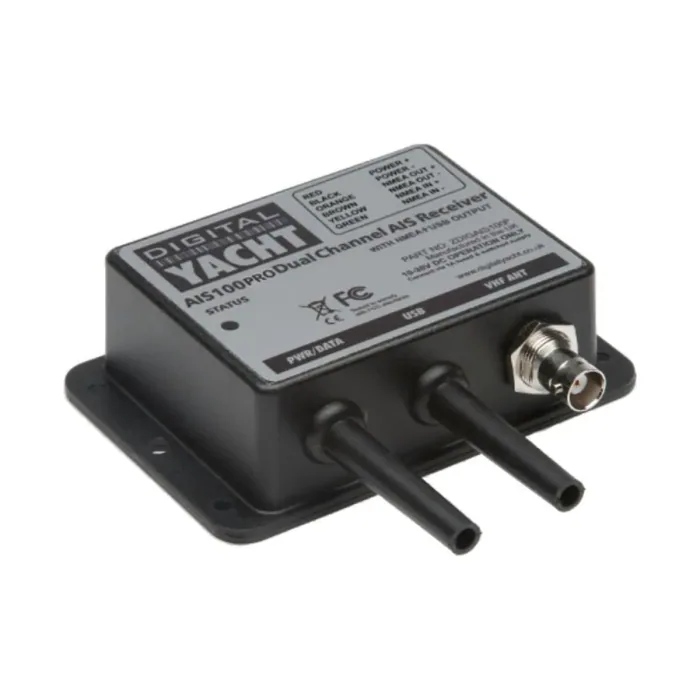
- USB and NMEA together. The AIS100 Pro adds a dual NMEA 0183 and USB output, so a PC and a dedicated plotter can be fed at once, and it will multiplex a slower 4,800 baud GPS input into the same output stream.
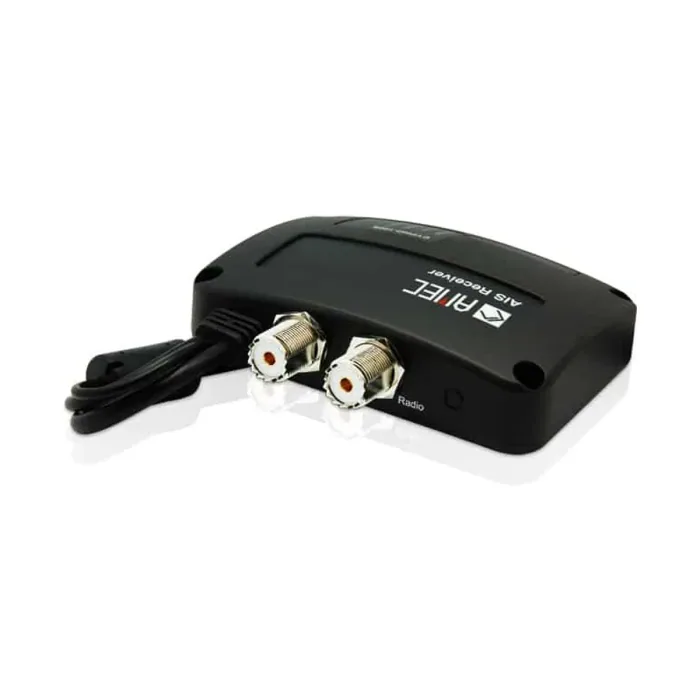
- Antenna sharing. The AMEC Cypho-150S includes a VHF pass through path across 156.025 to 162.025 MHz with 3.5 dB receive and 1.2 dB transmit insertion loss, so it can sit between an existing VHF radio and its antenna rather than requiring a second mast fitting. Output is NMEA 0183 at 38,400 baud by default or USB, drawing under 1.5 W from 12 or 24 V DC.
- Fixed monitoring installations. The AMEC R150GE WideLink adds two NMEA 0183 RS-422 interfaces, RS-232, USB and a 10/100 Base-T Ethernet port, which suits a shore station or bridge installation feeding several systems at once.
Getting the data onto a tablet
If the display you actually want is an iPad rather than a plotter, the receiver still needs a wireless bridge. A wireless NMEA multiplexer such as the Digital Yacht WLN30 Smart creates a password protected onboard Wi-Fi network and streams the receiver's output to apps such as NavLink, iAIS and other compatible charting apps, turning the tablet into a working AIS display without any additional cabling.
Antenna matters more than the box
Reception range is set by antenna height and quality far more than by the receiver's specification. The AIS band sits at the top of the marine VHF range, so an antenna tuned for it, such as the Digital Yacht KS30, will outperform a compromise fitting, and mounting it as high and as clear of obstructions as practical is the single most effective thing you can do. A receiver in a well sited installation will typically show targets out to around 20 to 30 nautical miles depending on the height of the transmitting vessel's antenna.
If you decide to transmit instead
Many buyers start with a receiver and later move to a transponder. If that is a likely path, it is worth reading the class comparison before committing, since a Class B transponder such as the AMEC B620S or the Digital Yacht iAISTX Plus does everything a receiver does and adds transmission. ASPL supplies both the AMEC and Digital Yacht ranges in India and can advise on which side of that line your operation sits.