
A fishing boat is a hard place to keep a radio alive. The set gets salt spray, diesel, wet hands and a permanent low-level vibration, the electrical supply is whatever the alternator and an ageing battery bank feel like providing, and the crew has neither the time nor the inclination to be careful with it. Specifying a VHF for that environment is less about maximum range on paper and more about which set is still working in year four.
Start with the fixed set
On any boat with a working 12 V system, the primary radio should be a 25 W fixed-mount with DSC. That gives you the transmit power and, more importantly, the masthead antenna height that actually determines VHF range, plus a distress alerting path that does not depend on somebody speaking clearly under pressure.
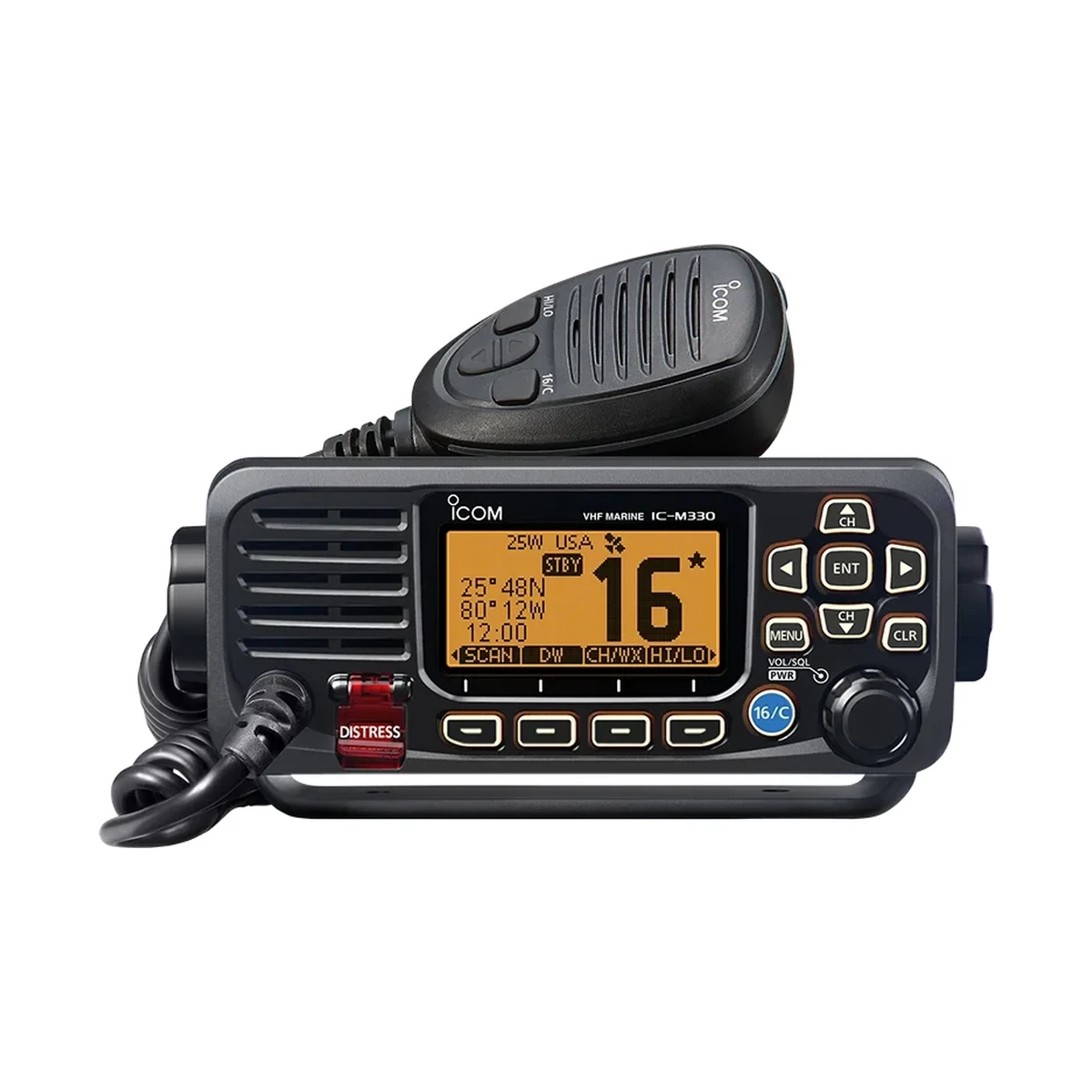
- Icom IC-M330. Compact at 156.5 x 66.5 x 88.2 mm and 730 g, 25 W with a 1 W low setting, built-in Class D DSC and NMEA input and output. The size matters on a small wheelhouse console where there is nothing like the panel space a specification sheet assumes.
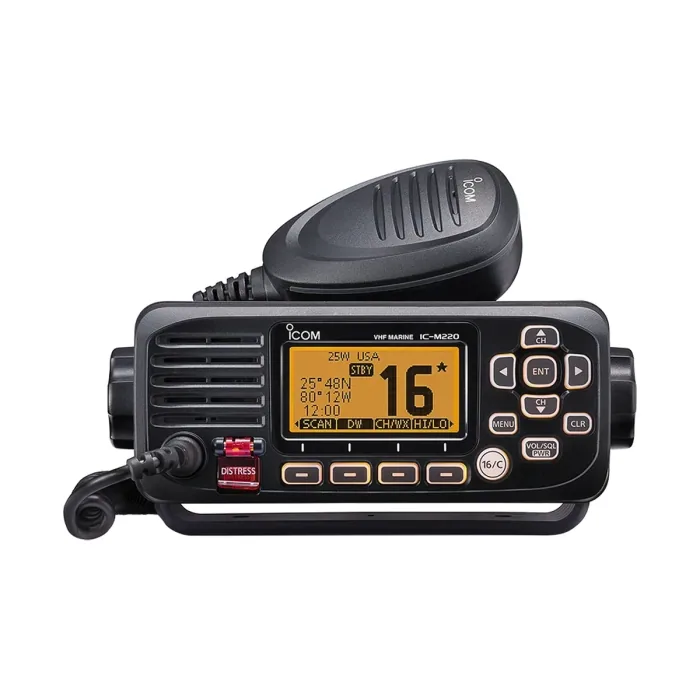
- Icom IC-M220. Similar footprint with a front-mounted speaker, which is the right choice when the set has to be heard over an engine rather than seen.
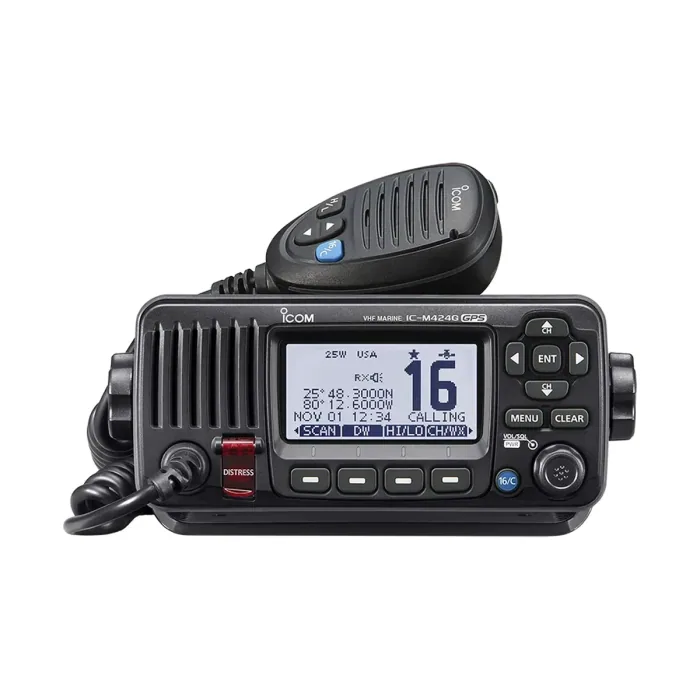
- Icom IC-M424G. Adds an internal 66-channel GPS receiver and NMEA 2000 output, so a DSC distress alert always carries a position without depending on a separate feed from a plotter that may or may not still be wired in.
- Samyung STR-7000A. 191 channels, 25 W and 1 W output, Class A DSC to ITU-R M.493-14, running from a 24 V input through its own supply, which suits larger deep-sea boats built around a 24 V system.
- Icom IC-M605 and IC-M510EVO. Where budget allows, both add dual-channel AIS receive on 161.975 and 162.025 MHz, giving a traffic picture on a boat that may not carry a full transponder.
Then the handhelds, and buy them properly
A handheld on a fishing boat is not a spare. It is the radio that goes to the rail during a haul, into the tender, and into a life raft. Two specifications matter more than any feature list: waterproofing and battery endurance.
- Icom IC-M37. 6 W high power, 293 g, IPX7, with a voice boost function that is genuinely useful next to a hydraulic hauler.
- Icom IC-M73PLUS. IPX8, 6 W, 3 W and 1 W output steps, a robust choice where the set spends its life wet.
- Icom IC-M94D. 6 W with built-in DSC and an AIS receiver in a 357 g handheld, so the man-overboard case is covered by the radio the crew already carries.
- Entel HT644. 5 W, IP68 rated to two metres for four hours, MIL-STD 810 construction, 14.5 hours on a 2200 mAh pack. Built for abuse rather than for a chandlery shelf.
- Samyung STV-160. Full international, USA and Canadian channel coverage plus weather channels, eight hours on a 1350 mAh pack, at 420 g.
If the boat trades where GMDSS carriage applies
Larger deep-sea vessels fall under the carriage regime, and there the specification is not open. A type-approved GMDSS VHF such as the Icom GM600 with Class A DSC becomes the primary installation, survival craft sets such as the Icom IC-GM1600, built to IMO Resolution MSC.149(77) and rated for over eight hours at minus 20 degrees Celsius, are carried as a separate item, and MF/HF with DSC follows if the vessel works beyond VHF and MF coast station coverage. If your boat sits below the thresholds, none of that is mandatory, but the reasoning behind it still applies: two independent ways of being heard is a better plan than one.
The parts nobody quotes for
Most VHF complaints on fishing boats are not radio faults. They are antenna and power faults. Budget for a properly mounted whip as high as the boat allows, a good coaxial run with sealed connectors, and a fused supply taken from a sound point rather than spliced into the nearest convenient wire. Programme the MMSI as soon as it is issued, and wire a position source into the DSC set. A boat's radio range is decided by the mast and the coax long before it is decided by the model on the console.
ASPL supplies marine VHF, GMDSS and safety communication for fishing fleets across India, including supply under government fisheries schemes and the documentation those programmes require, with a nationwide collection network so a failed unit does not mean a lost season.