
AIS on a fishing vessel does two jobs at once. It makes the boat visible to shipping, which matters most at night and in the traffic lanes that cross many of India's fishing grounds. And it leaves a track, which matters when a boat is overdue and somebody has to work out where it was last seen. Neither job is served by the cheapest box that will fit.
Start with the carriage question
SOLAS Chapter V, Regulation 19 sets the international baseline: AIS is required on ships of 300 gross tonnage and upwards on international voyages, cargo ships of 500 gross tonnage and upwards on domestic voyages, and all passenger ships irrespective of size. Most fishing vessels fall outside those thresholds and are therefore not covered by the SOLAS requirement.
That does not settle the question in Indian waters. Requirements for fishing vessels depend on vessel length, registration, the state the vessel is registered in and the scheme under which equipment is being fitted, and they have changed over time. Before specifying equipment, confirm the current position with the vessel's registering authority, the relevant state fisheries department and the Directorate General of Shipping rather than relying on what was true for a neighbouring boat a few seasons ago. Where equipment is being supplied under a government fisheries scheme, the scheme's own specification usually decides the class and type outright.
Class A, Class B SO and Class B CS
Class A is the higher-power, higher-reporting-rate standard mandated for SOLAS vessels. It is built and type-approved to a heavier specification, includes a display and pilot plug, and costs and consumes accordingly. On a fishing vessel it is the right answer only where a rule or a scheme requires it, or on large deep-sea trawlers operating alongside commercial shipping. The AMEC A750 is an example, certified for both SOLAS and inland mode with a 4.3 inch sunlight-readable colour display and an integrated pilot plug, built to IEC 61993-2 Ed. 3.0 and related standards with an IPx6 rating. The Digital Yacht CLA2000 covers the same ground with a 5 inch integrated colour display and an IP67 rating.
Class B is the practical choice for most boats. It splits into two variants and the difference is worth understanding:
- Class B CS transmits at 2 W using carrier-sense channel access, listening for a free slot before transmitting. It is cheaper and draws less, but in congested water it competes for airtime and its reports can be delayed.
- Class B SO uses SOTDMA access with a reserved transmission slot and higher output, typically 5 W. Reports get through more reliably in busy traffic and effective range is better, at a higher cost and power draw.
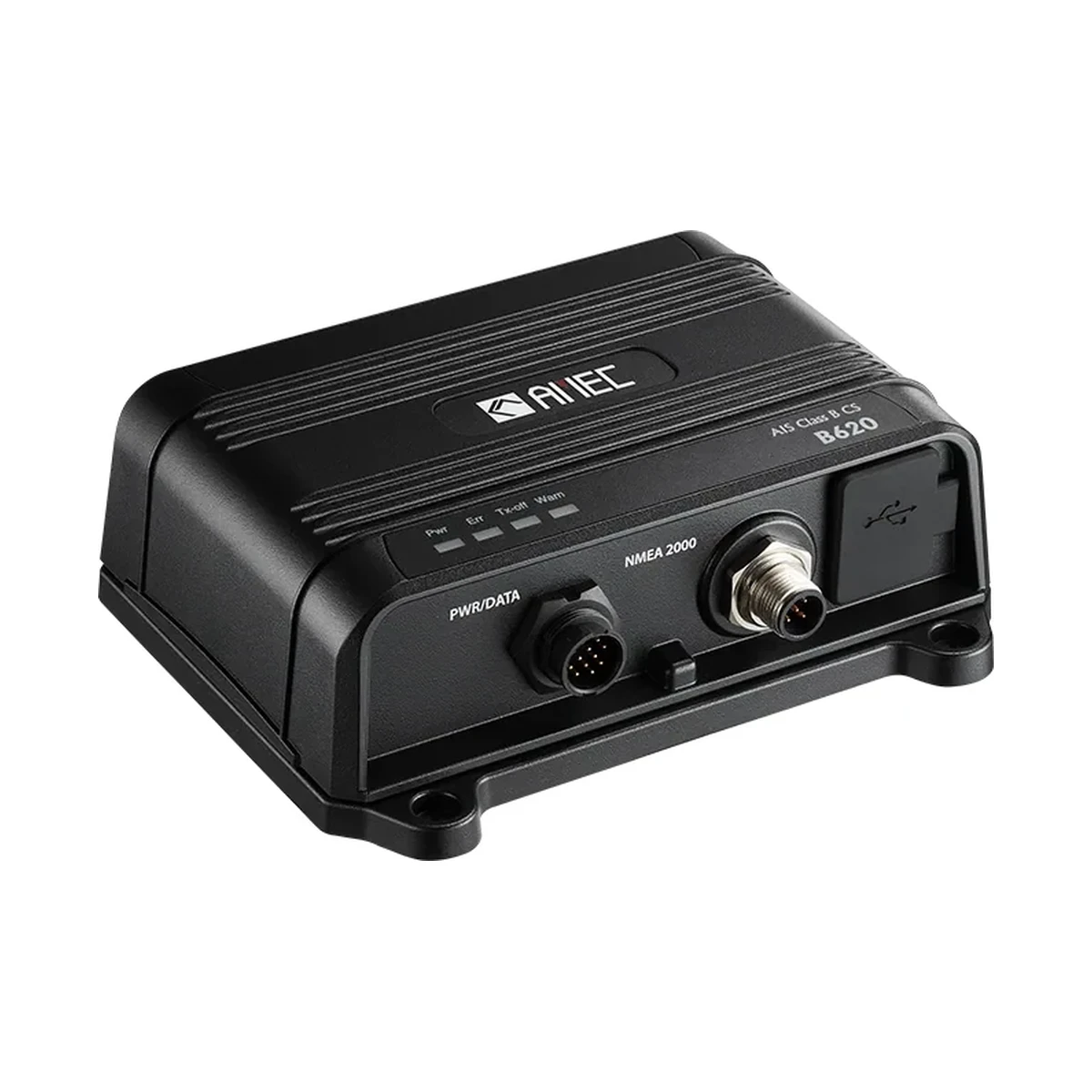
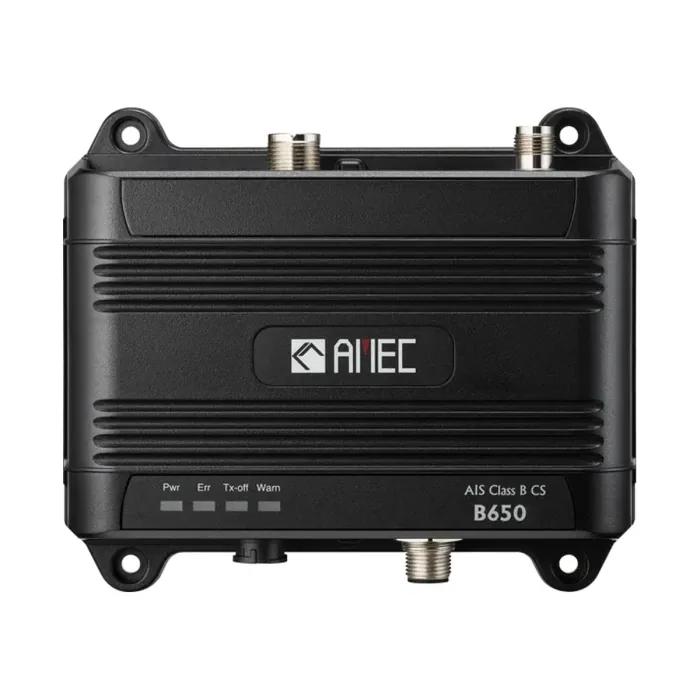
The AMEC B620 is a Class B CS transceiver built around a 72-channel multi-constellation GNSS receiver covering GPS, Galileo, BeiDou and GLONASS with 2.5 m horizontal accuracy, transmitting at 2 W with receive sensitivity better than -111 dBm, and outputting over two bi-directional NMEA 0183 ports, NMEA 2000 and a USB-C virtual COM port. It is IP68 rated and operates from -25C to +55C. The AMEC WideLink B650 is the SOTDMA equivalent on the same platform, with selectable 5 W or 1 W output and the same GNSS receiver, connectivity and environmental rating.
Antenna sharing and the second mast fitting
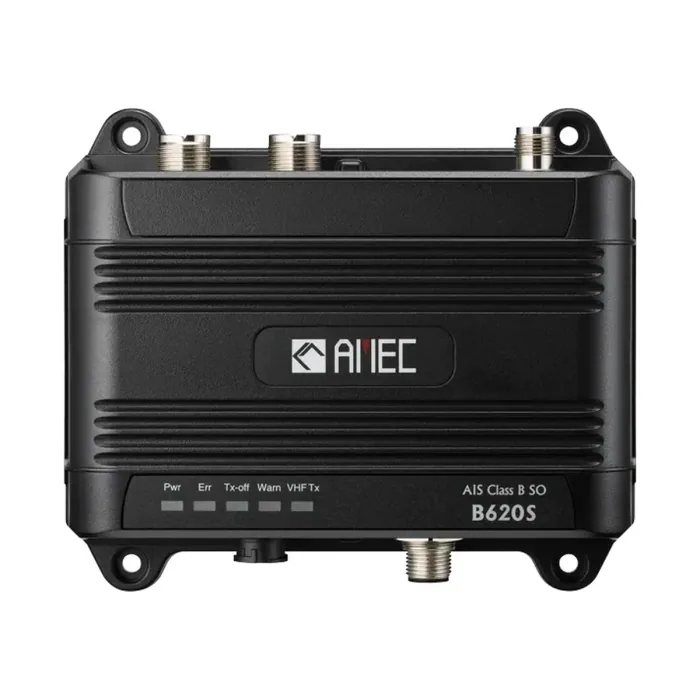
Most fishing boats already have a VHF antenna and limited space for another. A splitter lets the AIS transponder share it. Buying that as an integrated feature is usually cleaner than adding an external box: the AMEC B620S and AMEC WideLink B650S add an integrated VHF splitter with a dedicated radio connector to the B620 and B650 respectively, and the Digital Yacht AIT6000 is a Class B+ unit with an integral splitter, alarm output, NMEA 2000 and Wi-Fi.
The alternative is a dedicated antenna, which avoids any splitter loss on either the AIS or the voice path. Where a mast fitting is available, that remains the simpler installation. A combination AIS, VHF and GPS antenna such as the Digital Yacht GV30 reduces it to one fitting with twin coax feeds.
What actually decides it on a working boat
- Environmental rating. A fishing boat's electronics live in salt, spray and vibration. An IP68 rated enclosure is not a luxury specification on a working deck boat.
- Power draw. Transponders draw current on every transmit burst and should sit on their own adequately fused circuit rather than share with other electronics. Where the boat's supply is marginal, a 2 W CS unit is easier to live with than a 5 W SOTDMA one.
- What it has to talk to. If there is an existing chartplotter, check whether it expects NMEA 0183 or NMEA 2000, and choose a transponder that offers the right port rather than planning to add a converter later.
- Antenna position. Range is set by VHF antenna height and clear line of sight, and the GNSS antenna needs an unobstructed view of the sky. Mounted under a hardtop or beside gantry structure, both suffer.
- MOB and SART alarming. If crew carry AIS man overboard beacons, confirm the transponder or plotter alarms on those transmissions.
- Service access. A transponder that has to go back to another country for repair is a transponder that stays broken through the season.
Which one for which boat
For a small inshore boat where visibility to shipping is the whole point, a Class B CS transponder such as the B620 on a dedicated antenna is proportionate. For a boat working further out, crossing traffic lanes or operating in congested water, the extra reliability of a SOTDMA unit such as the WideLink B650 earns its cost. For large deep-sea vessels, or wherever a rule or a scheme specifies it, Class A is the requirement rather than the choice.
ASPL introduced marine GPS to India's fishing communities and supplies equipment under government fisheries schemes, including marine VHF, AIS and distress equipment, with a nationwide collection network behind the service side.